
Table of Contents
Summary
OYO’s IPO hasn’t opened yet, since parent company Prism has only filed confidential draft papers with SEBI to raise up to Rs 6,650 crore. But once bidding does open, most coverage will throw subscription numbers at readers with zero context. This piece explains exactly what QIB, NII, and retail subscription figures mean, and why a slow Day 1 rarely tells the full story, since institutional money typically arrives in the final hours of bidding, as seen with both Hyundai Motor India and WeWork India. It also lays out why OYO’s numbers deserve closer attention than most, given its 172 percent profit growth and ten straight quarters of positive EBITDA heading into the listing.
Key takeaways
QIB, NII, and retail are the three subscription categories, and each measures demand differently.
A slow Day 1 is common and does not reliably predict a weak IPO, since institutional bids usually land on the final day.
Hyundai Motor India and WeWork India both started slowly before institutional demand pushed them well past full subscription.
OYO’s 172 percent profit growth and ten consecutive EBITDA positive quarters give its eventual subscription numbers real context most IPOs don’t have.
GMP is an unofficial number and should never be the sole basis for a decision.
Introduction
OYO’s parent company, Prism, has filed confidential draft IPO papers with SEBI to raise up to Rs 6,650 crore. The exact opening date, price band, and lot size are not public yet, and they will only be confirmed once the company files its red herring prospectus closer to the actual listing. But once that window opens, you are going to see a flood of numbers on every finance app and news site, and most of them will be thrown at you with zero explanation. Here is what those numbers actually mean, so you are not left guessing on Day 1.
You can also track every company currently open for subscription on Listing Updates as this and other 2026 IPOs move through their bidding windows.
What Subscription Status Actually Tells You
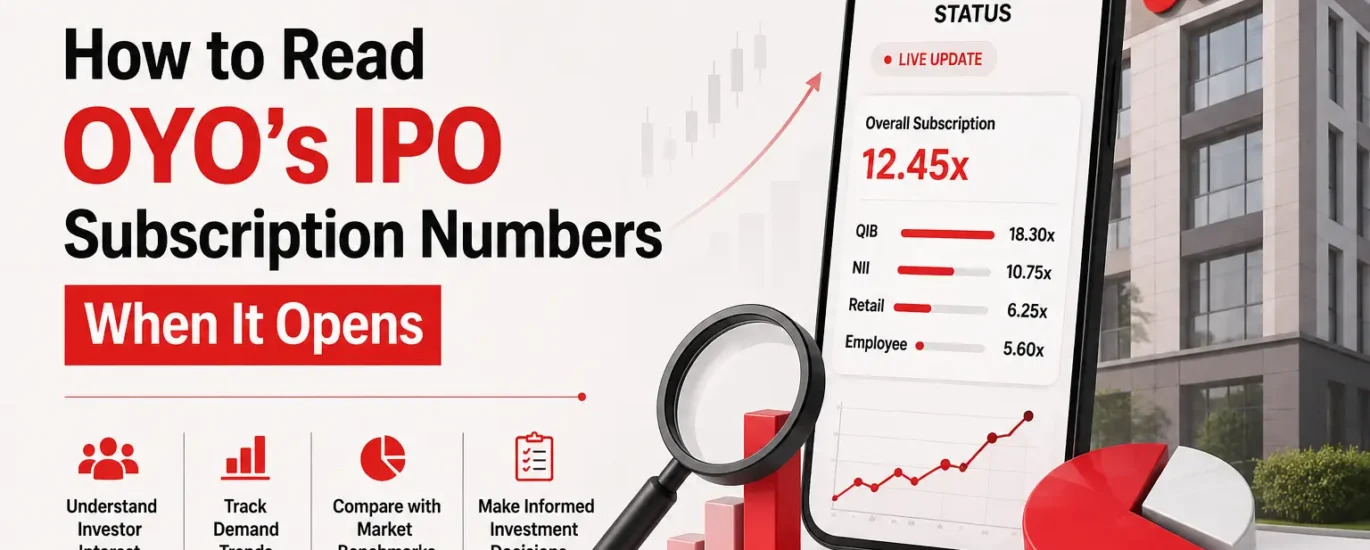
When an IPO opens, investors place bids for shares across three main groups. Each group has its own subscription number, and together they tell you how much demand the company is seeing before it even lists.
QIB stands for Qualified Institutional Buyers. This group includes mutual funds, insurance companies, and banks, and they generally make the largest bids.
NII stands for Non Institutional Investors. This covers high net worth individuals and entities applying with amounts larger than the retail limit allows.
Retail simply means individual investors applying within the standard retail limit, which is most people reading this.
If a category is subscribed one time, it means investors have applied for exactly as many shares as are on offer in that category. Two times means double the demand. Under one time means the category has not yet been fully covered.
If terms like these still feel unfamiliar, our plain language explainers section breaks down every common IPO term you will run into this year.
Why a Slow Day 1 Does Not Mean What You Think
Here is the part almost nobody explains clearly. QIB and NII money almost always shows up late, usually clustered into the final hours of the last bidding day.
Independent market analyst Ambareesh Baliga has explained that merchant bankers typically only take an IPO to market once they already have a solid institutional commitment lined up. That commitment usually does not show up as an actual bid until the very end of the bidding window, even though it was effectively locked in before the IPO even opened.
This pattern has played out publicly more than once recently. Hyundai Motor India’s IPO started slowly too, with retail and NII demand both lagging in the early days. Shivani Nyati, Head of Wealth at Swastika Investmart, noted that the size and full pricing of that issue made many investors cautious at first, before QIB demand surged and pushed the total subscription past two times by the final day.
WeWork India told a similar story. The issue barely crossed one time overall subscription, with retail and NII interest both underwhelming, before institutional buyers stepped in at the last moment and carried it through.
So if OYO’s Day 1 numbers look quiet when the IPO does open, that is not automatically a red flag. It is worth watching the full bidding window before drawing any real conclusion, not just the opening morning. You can follow how past debuts actually played out in our listing day results section.
What Makes OYO’s Numbers Worth Watching Closely
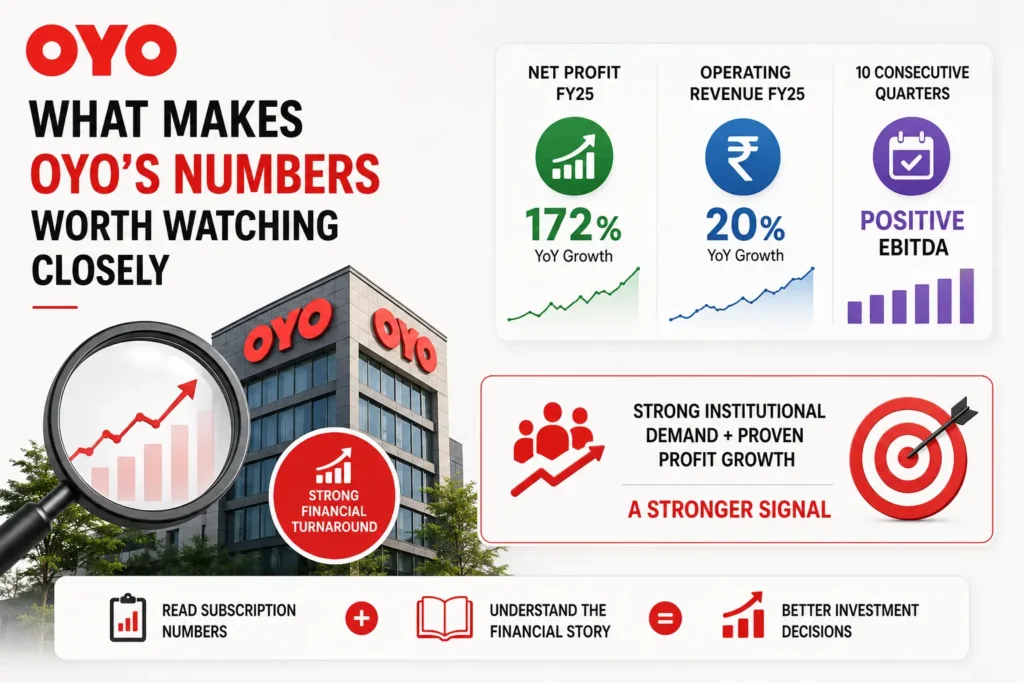
Most IPOs get judged purely on subscription numbers with no real context behind them. OYO is a slightly different case, because there is already a strong financial story sitting underneath the subscription data.
The company’s net profit grew 172 percent year on year to Rs 623 crore in FY25, while operating revenue grew 20 percent to Rs 6,463 crore. On top of that, OYO has delivered 10 consecutive quarters of positive EBITDA, which is a genuinely rare streak among companies going public in India this year. We cover this turnaround in more depth in our OYO company profile.
That track record matters because it gives you a real way to judge whether the eventual subscription numbers make sense. Strong institutional demand on a company with real, proven profit growth is a very different signal than the same subscription number on a company that is still losing money. When OYO’s IPO does open, it is worth reading the subscription numbers alongside that profitability story rather than looking at either one in isolation.
A Quick Word on Grey Market Premium
You will also see GMP, or grey market premium, mentioned constantly once OYO’s IPO opens. This is an unofficial, unregulated number that reflects what unlisted shares are informally trading at ahead of listing.
It can be a useful early signal of sentiment, but it is not a reliable predictor on its own. GMP has moved sharply in both directions for plenty of IPOs in the days right before listing, so treat it as one small data point rather than a basis for any decision.
Frequently Asked Questions
Has OYO’s IPO opened for subscription yet?
Not yet. OYO’s parent company, Prism, has filed confidential draft papers with SEBI to raise up to Rs 6,650 crore, but the opening date, price band, and lot size have not been announced publicly.
What does it mean if an IPO category is undersubscribed on Day 1?
It means investors have not yet applied for as many shares as are available in that category. This is common early in the bidding window, especially for QIB and NII categories, since institutional demand tends to arrive closer to the final day.
Why do QIBs and NIIs usually bid late in an IPO?
Institutional commitments are typically arranged before the IPO even opens, but the actual bids often get placed in the final hours of bidding rather than spread evenly across all the days.
Is grey market premium a reliable way to predict listing day performance?
No. GMP is an unofficial, unregulated figure and should be treated as one small signal among several, not a reliable predictor on its own.
Why does OYO’s IPO get extra attention compared to other 2026 listings?
Because it combines real, proven profitability, including 172 percent profit growth in FY25 and 10 straight quarters of positive EBITDA, with a large enough issue size to draw serious institutional interest. That combination is uncommon in this year’s IPO pipeline.
Conclusion
OYO’s IPO has not opened yet, but the groundwork for understanding it is already worth laying down. Subscription numbers on their own tell you very little without context, and the biggest mistake most first time IPO watchers make is reading a slow opening day as a bad sign. History says otherwise more often than not, since institutional money from QIBs and NIIs tends to show up right at the finish line rather than the starting gate.
What makes OYO worth following closely is not just the eventual subscription multiple, it is what sits underneath it. A company posting 172 percent profit growth and ten straight quarters of positive EBITDA gives you something most IPOs do not, a real, checkable reason to believe strong demand would be justified rather than just hype driven. Whether the actual numbers live up to that story is something only the real bidding window will tell you.flisting
For now, the smartest thing you can do is understand exactly what QIB, NII, and retail subscription figures mean, watch the full three days rather than reacting to Day 1 alone, and treat GMP as background noise rather than a signal to act on. Once OYO’s dates are confirmed, that groundwork means you will be reading the real numbers with context, not just watching a ticker.
This article is for informational purposes only and does not constitute investment advice. Please review the company’s official offer document once available, and consult a SEBI registered financial advisor before making any investment decision.