

Table of Contents
Summary
Most IPO advice stays generic, telling you to know your risk tolerance without naming a single real company. This article fixes that by matching four investor profiles to actual 2026 and 2027 listings, using one simple lens, whether an IPO is a fresh issue or an offer for sale. Conservative investors fit best with NSE, an offer for sale listing built on stability. Growth focused investors fit best with OYO, a fresh issue turnaround story with real upside and real risk. Scale seekers fit best with Reliance Jio and eventually Flipkart. First time applicants get practical guidance on starting simple and learning to read a filing properly, rather than being pointed toward the most complicated listing on the list.
Key Takeaways
- There is no single best IPO in 2026 and 2027, only the one that actually fits your specific risk tolerance and investment goals
- The most useful lens for matching an IPO to an investor is whether it is a fresh issue, where money goes into the company, or an offer for sale, where money goes to existing shareholders cashing out
- NSE’s IPO is structured entirely as an offer for sale, making it a fit for conservative, income focused investors who prioritize stability over speculative upside
- NSE cannot list on its own trading platform due to regulatory rules, so its shares are proposed to list on BSE instead, a small but genuinely interesting structural detail
- OYO’s IPO is a 100 percent fresh issue built around a real profitability turnaround, making it a fit for growth focused investors comfortable with higher risk
- Reliance Jio and, eventually, Flipkart suit investors who want exposure to the largest, most talked about names in Indian IPO history, though size does not guarantee strong post listing performance
- First time IPO applicants are generally better served starting with simpler, smaller, more established listings rather than the most complex or speculative option available
- Learning to properly read a company’s own IPO filing is a transferable skill that helps with any listing, not just one specific company
- The current 2026 to 2027 IPO pipeline spans a genuinely wider mix of sectors than earlier cycles, including telecom, financial market infrastructure, hospitality, e-commerce, fintech, and renewable energy
- Sector conviction can be layered on top of risk tolerance as a second, equally valid way to decide which IPO actually fits an individual investor
introduction
Every guide on choosing an IPO tells you the same thing. Know your risk tolerance. Read the prospectus. Don’t chase the hype. That advice is not wrong, but it is also not very useful, because it never actually tells you which real company, filing right now, actually matches the kind of investor you are.
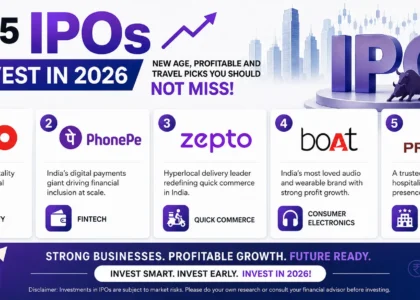
Meanwhile, India is heading into one of the biggest IPO stretches it has ever seen. Reliance Jio, NSE, OYO, Flipkart, and PhonePe are all moving through different stages of the pipeline at the same time. So the real question is not which one of these is the best IPO. It is which one actually fits you. This article walks through four common investor profiles and matches each one to a real listing currently in motion, using one simple idea as the guide, whether the money you invest goes to the company or to the people already holding shares.
The One Distinction That Matters Most

Before picking any IPO, there is a single detail worth understanding, and it explains more about fit than almost anything else.
Some IPOs are a fresh issue, meaning the money raised goes straight into the company itself, to fund growth, pay down debt, or expand operations. Other IPOs are structured as an offer for sale, meaning existing shareholders are simply selling some of their shares to the public, and the money goes to them, not the business.
NSE’s upcoming listing is a great example of this. Its IPO is structured entirely as an offer for sale, meaning the exchange itself receives no fresh capital from the listing. There is also an interesting rule behind this, an exchange is not allowed to list on its own trading platform, which is why NSE’s shares are proposed to list on BSE instead. This kind of structural detail matters, because an offer for sale listing usually means you are buying into a business that is already fully built and proven, while a fresh issue listing usually means you are backing a company that still has real growth or repair work ahead of it.
Keep this distinction in mind as you read through the profiles below, since it is the simplest, most practical way to judge whether a given IPO actually fits what you’re looking for.
If You Are a Conservative, Income Focused Investor
You prioritize stability over excitement. You would rather own a piece of something already proven than bet on a story still being written.
NSE fits this profile well. It is an established, profitable, systemically important institution at the center of India’s entire capital markets system, and its IPO is structured entirely as an offer for sale, meaning there is no fresh capital risk sitting inside the business itself from this listing. You are simply buying into an already mature, stable operation.
The trade off is worth knowing too. Buying stability usually means buying at a price that already reflects that stability. There is less room here for the dramatic upside a newer, riskier story might offer.
If You Are a Growth Focused Investor With Higher Risk Tolerance
You are comfortable with volatility. You are genuinely interested in turnaround stories, companies still proving themselves, and the possibility of real upside if execution goes right.
OYO is the clearest match here. Its IPO is a 100 percent fresh issue, meaning every rupee raised goes directly into the company, mostly toward paying down debt and strengthening its balance sheet. This is a genuine turnaround story, with real operational improvement behind it, but also real complexity still worth understanding before you invest.
If this profile sounds like you, it is worth going deeper than just this summary. We have covered OYO’s profit turnaround in detail, including how much of its reported profit is real versus one time gains. We have also broken down why most of its IPO money is going toward debt repayment, how its business model actually works against Airbnb and Booking.com, and whether its expected valuation makes sense given everything else going on. If you’re the kind of investor drawn to a genuine comeback story, this is the name worth studying closely before you decide.
If You Want Exposure to India’s Biggest, Most Talked About Names
You are less interested in a specific niche story and more interested in owning a piece of the biggest companies making headlines, the ones that could genuinely reshape how big Indian IPOs get.
Reliance Jio fits this profile clearly. It is expected to be one of the largest IPOs in Indian history, built on a business that has already transformed how India uses mobile data and digital services. Flipkart also belongs in this category, though it is a step behind in the process, having completed its move from Singapore back to India earlier this year and now preparing to file its own paperwork, with a listing more realistically expected in late 2026 or into 2027.
The real trade here is that big size and lots of attention do not automatically mean good results after the listing. A valuation that big already includes a lot of expected growth so there is chance for good surprises to help you. The big valuation already includes a lot of expected growth. There is less chance, for good surprises to help you.
If You Are a First Time IPO Applicant
You are new to this entirely, and the most speculative or structurally complicated listing on the list is probably not the right place to start.
Rather than pointing you to one specific company here, the better advice is about approach. Look for listings with simpler business models, clearer financial histories, and smaller, more manageable lot sizes while you get comfortable with how the process actually works. And regardless of which IPO you eventually choose, learning how to actually read a company’s own filing is a skill that will serve you well beyond just one listing. We put together a full, practical guide on how to read an IPO document before applying, using OYO’s own filing as a real, worked example, and the same reading approach applies to any company’s paperwork you come across in the future.
A Quick Note on Sector Diversity in This Pipeline
One more thing worth knowing before you pick a lane. The current wave of Indian IPOs looks genuinely different from earlier cycles. Instead of being dominated almost entirely by consumer tech and financial services, this pipeline spans telecom, financial market infrastructure, hospitality, e-commerce, fintech, and even renewable energy. That means you can layer sector conviction on top of investor profile too. If you believe strongly in one particular part of the economy, that can be just as valid a filter as risk tolerance alone.
Match Yourself: A Simple Summary

Conservative, income focused investors are best matched with NSE, an offer for sale listing built around stability rather than fresh growth capital.
Growth focused investors with higher risk tolerance are best matched with OYO, a fresh issue built around a genuine turnaround story still proving itself.
Investors chasing scale and headline names are best matched with Reliance Jio, and eventually Flipkart, both representing some of the largest listings in Indian market history.
First time applicants are best served by starting with simpler, smaller, more established listings while learning to read a company’s own filing carefully before applying.
Frequently Asked Questions
Which IPO fits your investor profile in 2026 and 2027?
It depends on your risk tolerance and goals. Conservative investors tend to fit best with stable, offer for sale listings like NSE, while growth focused investors tend to fit better with fresh issue turnaround stories like OYO.
Is OYO’s IPO good for growth investors?
Yes, OYO is structured as a 100 percent fresh issue built around a genuine profitability turnaround, making it a reasonable fit for investors comfortable with higher risk in exchange for potential upside.
Is NSE’s IPO a safe pick for conservative investors?
NSE is a stable, established institution, and its IPO is structured entirely as an offer for sale, meaning there is no fresh capital risk added to the business itself, which generally suits more conservative investors.
What is the difference between a fresh issue and an offer for sale IPO?
A fresh issue sends the money raised directly into the company for growth or debt repayment, while an offer for sale simply transfers existing shares from current shareholders to new investors, with no money going to the company itself.
Which IPO is best for first time investors?
Rather than picking the most complex or speculative listing, first time investors generally do better starting with simpler, smaller, more established companies, and taking the time to properly read the company’s own filing before applying.
Final Thought
There is no single best IPO in 2026 and 2027. There is only the one that actually fits what you’re trying to achieve and how much uncertainty you’re comfortable sitting with. Whether that means the stability of NSE, the turnaround story of OYO, the sheer scale of Reliance Jio, or simply taking your time to learn the ropes before applying to anything at all, matching the IPO to yourself matters far more than chasing whichever name is loudest in the headlines that week.
For deeper coverage on any of these listings as they move through the pipeline, keep following Listing Updates.
This article is meant for informational and educational purposes only and does not constitute investment advice. Please read the official filings yourself and consult a financial advisor before making any investment decisions.