
Table of Contents
Summary
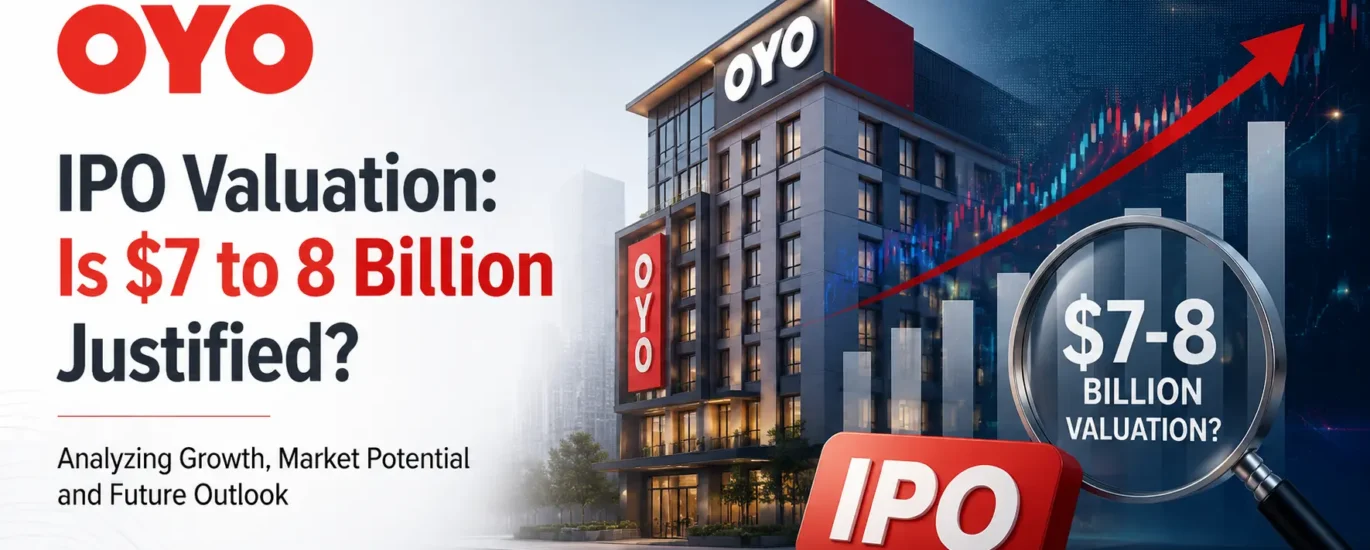
OYO’s valuation history reads like a rollercoaster. From a roughly 10 billion dollar peak in 2019, down to just 2.4 billion dollars in a private round eighteen months before this IPO, back up to a 7 to 8 billion dollar public listing target now. This article looks at if the price is really fair. It talks about the conditions that need to be met for the company to make money and grow.
We also look at the reason why OYO had to do its IPO at this time because of the pressure from loans. There is a difference between what Moodys thinks OYO will make and what OYO itself thinks it will make. The article also talks about if OYO can compete with Airbnb and Booking.com. It says that OYOs way of doing business, where it operates and franchises, helps protect it from competition but it also means OYO has to deal with risks. OYO has to do more things than Airbnb and Booking.com and this is what the article is about OYO and its ability to compete with other companies, like Airbnb and Booking.com.
Key Takeaways
- OYO’s valuation has swung dramatically, from a roughly 10 to 12 billion dollar peak in 2019 and 2021, down to just 2.4 billion dollars in a private round about eighteen months ago, back up to a 7 to 8 billion dollar IPO target now
- Whether OYO’s $7 to 8 billion valuation is justified depends on whether investors believe its recent profitability and global growth can be sustained, not just on the headline growth numbers alone
- Insiders including SoftBank, Ritesh Agarwal, Microsoft, and Airbnb are not selling any shares in this IPO, which can be read either as confidence in future upside or reluctance to lock in a poor return on their earlier investment
- Founder Ritesh Agarwal’s personally guaranteed 2.2 billion dollar loan from SoftBank founder Masayoshi Son has added real pressure around the IPO’s timing, an underused detail that adds context to why this listing is happening now
- At the targeted valuation, OYO trades at roughly ten times sales, alongside more than seven thousand crore rupees in outstanding debt still to be managed
- Moody’s projects a higher FY26 EBITDA for OYO than the company’s own management guidance, an unusual reversal that adds a small but genuine credibility signal
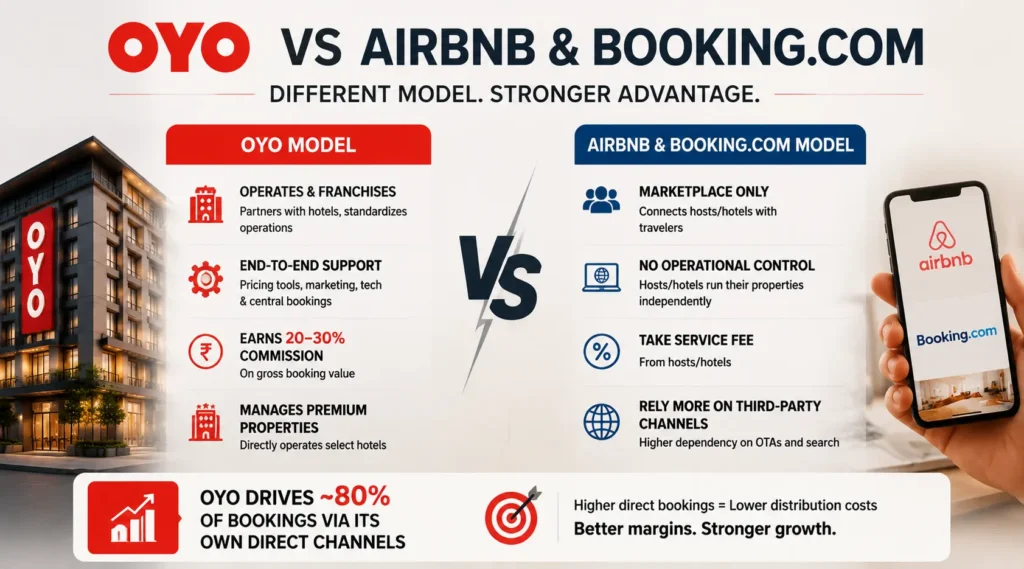
- OYO competes differently by operating and franchising accommodation, rather than just being a booking platform, unlike the pure marketplace models used by Airbnb and Booking.com
- OYO drives roughly 80 percent of its bookings through direct channels, compared to an industry average closer to 50 percent, reducing its dependency on costly third party platforms
- OYO’s operating model offers real protection against platform disintermediation risks like AI travel assistants and Google’s growing control of travel search, but it also comes with higher fixed costs and integration risk, as seen in the G6 Hospitality leadership turnover
- If OYO sustains its financial turnaround and lists at a reasonable valuation, it could be an attractive long term opportunity, but execution and valuation will be the deciding factors
Introduction
Eighteen months ago, OYO’s own investors valued the company at just 2.4 billion dollars in a private funding round. That is despite roughly 3.3 billion dollars of equity and debt having already gone into the company by that point, meaning OYO was worth less than the money invested in it. Now the company is asking public investors to pay roughly three times that private round price, targeting a valuation of 7 to 8 billion dollars for its IPO.
That kind of swing is not something you see every day, and it is the single most important piece of context for anyone trying to decide whether this valuation makes sense. This article is about OYO. How OYO got to be worth so much money. We will look at if the current price of OYO is fair. We will also compare OYO to Airbnb and Booking.com because that is a part of figuring out if OYO is really worth what people say it is. OYO and its business model will be compared to Airbnb and Booking.com to see how OYO stacks up against these companies. The comparison of OYO, to Airbnb and Booking.com is really important when we talk about the value of OYO.
The Wild Ride: How OYO’s Valuation Actually Got Here
To understand where OYO stands today, it helps to see the full journey.
Back in 2019 and into the first IPO attempt in 2021, OYO’s parent filed for a valuation of roughly 11 to 13 billion dollars, the peak of investor enthusiasm for the company, driven largely by rapid global expansion and the broader boom in startup valuations at the time.
Then came a sharp fall. As the pandemic disrupted travel and OYO worked through years of restructuring, its valuation dropped dramatically. In a private funding round roughly eighteen months before this IPO filing, OYO was valued at just 2.4 billion dollars, a fraction of its earlier peak and, remarkably, less than the total capital that had already been invested in the company.
Now OYO is back with a public listing targeting 7 to 8 billion dollars, roughly three times what its own investors paid just eighteen months earlier. Few companies survive a valuation fall like OYO’s, and fewer still come back from it the way OYO appears to be attempting now. Some market commentary has even floated a much lower valuation range for this listing, closer to 1 to 3 billion dollars in certain retail investor discussions, showing just how much genuine disagreement still exists about what OYO is actually worth. This round trip, from a ten billion dollar high, down to a 2.4 billion dollar low, and back up toward 7 to 8 billion, is the real story behind this IPO, and it deserves far more attention than it usually gets.
Is OYO’s $7 to 8 Billion Valuation Justified
This is the question every potential investor wants answered clearly, and honestly, the answer depends on whether investors believe its recent profitability and global growth can be sustained.
There are really two things you need to believe for this valuation to make sense. First, that OYO’s recent profit turnaround is genuinely repeatable and not just a temporary accounting boost. We covered this in detail in our breakdown of OYO’s PAT growth in 9MFY26, where we found that OYO’s real, adjusted profit is meaningfully smaller than its headline number once you remove one time gains, but the underlying operational improvement still looks genuine.
Second, you need to believe that OYO’s international growth, powered heavily by acquisitions like G6 Hospitality, can keep compounding rather than plateauing. We explored this fully in our piece on how OYO makes money through its growth strategy and acquisitions. If both of these things hold true over the next few years, the current valuation starts to look reasonable. If either one stalls, the price starts to look expensive very quickly.
Reading the Signals: What Insiders Not Selling Actually Tells You
One detail getting a lot of attention is that OYO’s biggest shareholders, including SoftBank, founder Ritesh Agarwal, Microsoft, and Airbnb, are not selling a single share in this IPO. The entire offering is a fresh issue, meaning all the money raised goes into the company rather than into the pockets of existing investors cashing out.
The easy, flattering interpretation is that insiders holding onto their shares signals real confidence in future upside. That may well be true.
But there is another way to read the exact same fact, one that independent analysis of the IPO structure has pointed to directly. These are the same investors who held OYO through the ten billion dollar highs and the 2.4 billion dollar lows. Choosing not to sell at 7 to 8 billion dollars could simply mean they do not want to lock in a poor return on their earlier investment, rather than expecting significant further growth. Both readings are reasonable, and a fair analysis should present both rather than assuming the more optimistic one is automatically correct.
The Personal Pressure Behind the Timing
Here is a detail that rarely gets mentioned but genuinely matters for understanding why this IPO is happening now, at this particular price.
Founder Ritesh Agarwal personally secured a loan of around 2.2 billion dollars back in 2019 to raise his own stake in the company, a loan personally guaranteed by SoftBank founder Masayoshi Son. Conditions tied to this loan have reportedly added real pressure around OYO’s IPO timeline over the past couple of years.
This does not mean the valuation itself is wrong. But it does add useful context. The reason OYO is doing this now is because of the founders money problems. It is not about what is good for the company or what is happening in the market. When you know this it makes sense why OYO is going ahead with this public offering now instead of waiting to see what the market is, like later on. OYO is moving forward with this public offering at this time.
The Numbers Behind the Price
A few more figures help round out the picture.
At a 7 to 8 billion dollar target, OYO’s valuation implies a multiple of roughly ten times its sales. That is not an unusually extreme number for a growing technology-driven hospitality company, but it is also not a cheap one, especially alongside more than seven thousand crore rupees in outstanding debt, which we covered in detail in our article on OYO’s debt and IPO proceeds.
There is also an interesting gap worth noting between different profit projections for OYO’s upcoming year. Moody’s reaffirmed a B2 rating on OYO with a stable outlook and projected FY26 EBITDA of around 2,496 crore rupees, driven by the G6 Hospitality acquisition and cost improvements, while OYO’s own management guidance targets a more conservative 2,000 crore rupees. Usually you see the opposite pattern, where a company’s own guidance is more optimistic than what independent analysts project. Here it is reversed, which is a small but genuinely reassuring detail about how OYO’s management is setting expectations.
Can OYO Compete With Airbnb and Booking.com
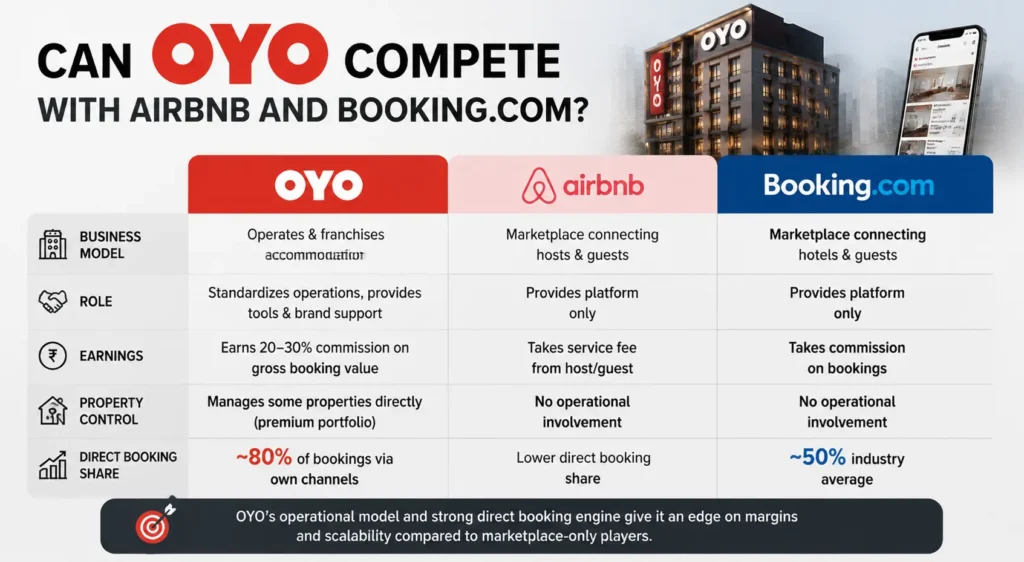
This question sits right at the center of the whole valuation debate, and the direct answer is that OYO competes differently by operating and franchising accommodation, rather than just being a booking platform.
Airbnb and Booking.com are, at their core, marketplaces. Hosts and hotel owners list their properties, set their own prices, and the platform simply connects them with travelers and takes a fee for the transaction. Neither company gets involved in how a property is actually run day to day.
OYO works differently. It partners with hotel owners, standardizes their operations under the OYO brand, provides dynamic pricing tools, digital marketing, and centralized booking systems, and in return earns a commission typically in the range of 20 to 30 percent of gross booking value. In some cases, particularly with its growing premium portfolio, OYO goes even further and directly manages properties itself, something we covered in our comparison of OYO against Indian Hotels.
This operational involvement shows up clearly in one important number. OYO drives roughly 80 percent of its bookings through its own direct channels, compared to an industry average closer to 50 percent. That matters a lot for margins, since it means OYO is far less dependent on paying commissions to third party platforms like Google or other travel search engines to fill its rooms, a cost that keeps rising for companies that rely more heavily on marketplace-style distribution.
Why This Difference Actually Matters for the Valuation
Here is where the business model comparison and the valuation question come together, and this is genuinely the most important argument in this entire article.
Being an operator instead of a pure marketplace gives OYO a real structural advantage against a specific kind of risk that increasingly worries investors in travel technology companies. As artificial intelligence powered travel assistants and Google’s growing control over travel search change how people find and book accommodation, pure marketplace platforms face a real risk of being cut out of the process entirely, since their whole value lies in connecting supply and demand, a role technology could increasingly automate. OYO’s deeper operational involvement, its branding, its standardized service quality, and its direct customer relationships make it harder to simply route around in the same way.
But this advantage comes with a real cost too, and it would be dishonest to leave that part out. Operating and franchising properties directly means higher fixed costs, more complex relationships with franchisees, and real integration risk when things go wrong. We saw a live example of this in our breakdown of the G6 Hospitality acquisition in our growth strategy article, where a near complete executive turnover followed the deal, a genuine reminder that running hotels is harder and riskier than simply listing them on an app.
So the honest answer to whether OYO’s model justifies its valuation against Airbnb and Booking.com is this. It offers real protection against a risk that pure marketplaces face, but it also takes on operational risks that marketplaces simply do not have to worry about. Whether that trade off is worth the current price depends entirely on how well OYO continues to execute.
A Quick Look at OYO’s Regional Competitors
OYO is not the only company using this franchise style model. RedDoorz operates roughly 3,000 hotels across Southeast Asia using a very similar approach, standardizing small hotels and charging commission on room revenue. The key difference is scale and geography. RedDoorz stays focused on Indonesia and neighboring markets, which allows for closer local relationships but limits how big the business can realistically get. OYO’s global footprint, especially after the G6 Hospitality acquisition in the United States, is what genuinely sets it apart from smaller regional players running a similar playbook.
Will the OYO IPO Be a Good Investment in 2026
Bringing everything together, the honest answer is that if OYO sustains its financial turnaround and lists at a reasonable valuation, it could be an attractive long term opportunity, but execution and valuation will be key.
The operational story is genuinely improving. The international growth is real. The business model gives OYO a meaningful structural edge over pure marketplace competitors like Airbnb and Booking.com. But the valuation still requires a lot to keep going right, sustained profitability, continued international momentum, successful integration of recent acquisitions, and steady progress on paying down debt. None of these are guaranteed, and the company’s own history of a dramatic valuation swing over the past few years is a reminder of just how quickly the picture can change.
Frequently Asked Questions
Is OYO’s $7 to 8 billion valuation justified?
It depends on whether investors believe its recent profitability and global growth can be sustained. The valuation looks reasonable if OYO’s operational improvements and international expansion continue, and expensive if either one slows down.
Can OYO compete with Airbnb and Booking.com?
OYO competes differently by operating and franchising accommodation, rather than just being a booking platform. This gives it more control over service quality and pricing, along with meaningfully lower dependency on third party platforms for bookings.
Why did OYO’s valuation drop from $10 billion to $7 to 8 billion?
OYO’s valuation fell sharply during the pandemic and its aftermath, reaching as low as 2.4 billion dollars in a private round about eighteen months before this IPO. The current 7 to 8 billion dollar target reflects a genuine recovery, though it remains well below the company’s earlier peak.
Is OYO overvalued compared to its earnings?
At roughly ten times sales, the valuation is not extreme for a growing hospitality technology company, but it is not cheap either, especially alongside meaningful outstanding debt and a profit picture that looks smaller once one time gains are excluded.
Will the OYO IPO be a good investment in 2026?
If OYO sustains its financial turnaround and lists at a reasonable valuation, it could be an attractive long term opportunity, but execution and valuation will be key. Investors should weigh the company’s genuine operational progress against the real risks still ahead.
Conclusion
OYO’s valuation journey over the past few years has been genuinely dramatic, and the 7 to 8 billion dollar IPO target sits somewhere between a fair reflection of real operational progress and a price that still assumes a lot will keep going right. The strongest argument for this valuation is not just growth numbers, it is OYO’s operating model itself, the fact that it competes with Airbnb and Booking.com by actually running and standardizing accommodation rather than simply listing it, which offers real protection against risks that pure marketplace platforms increasingly face. Whether that argument is worth the current price will become clearer as OYO’s profitability, debt repayment, and international growth continue to play out in the months ahead.
For the fuller picture behind this valuation, read our detailed breakdown of OYO’s PAT growth in 9MFY26, our look at OYO’s debt and how the IPO addresses it, and our explainer on how OYO makes money through its growth strategy and acquisitions.
This article will be updated once OYO’s final RHP confirms the official price band and valuation. For more coverage like this as OYO’s IPO moves forward, keep following Listing Updates.