
Table of Contents
Summary
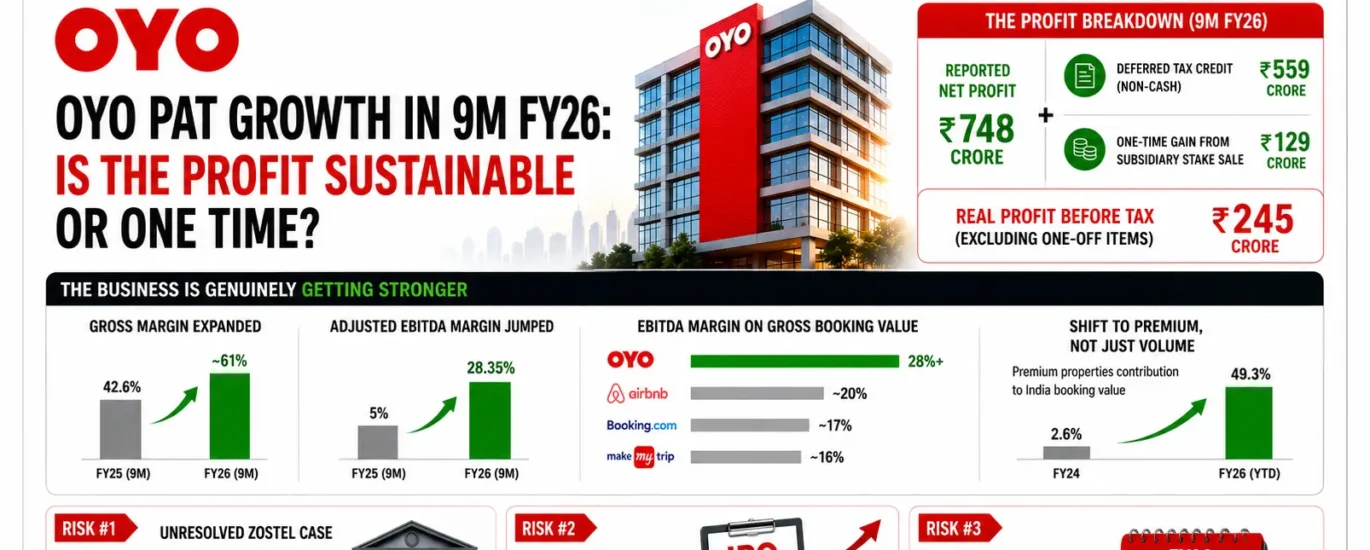
OYO reported a net profit of ₹748 crore for the first nine months of FY26, a number that looks like a major turnaround story. But nearly ₹559 crore of that profit came from a deferred tax credit, a non cash accounting entry, not money the company actually earned from running hotels. Strip that out, along with a separate ₹129 crore one time gain from a subsidiary stake sale, and OYO’s real profit before tax for the period drops to around ₹245 crore.
At the same time, the underlying business genuinely has gotten stronger. Gross margins expanded from 42.6 percent to nearly 61 percent, adjusted EBITDA margin jumped from 5 percent to 28.35 percent of revenue, and OYO’s EBITDA margin on gross booking value now beats Airbnb, Booking.com, and MakeMyTrip. The company has also quietly shifted from a budget listing platform into a company managed premium hospitality business, with premium properties going from 2.6 percent to 49.3 percent of India’s booking value in under two years. Alongside this, two real risks remain largely unreported elsewhere: an unresolved Supreme Court case with Zostel that could force up to 7 percent equity dilution, and an IPO issue size that is actually larger than OYO’s entire net worth. The honest verdict is that OYO’s operational turnaround looks real and increasingly sustainable, but the headline profit figure significantly overstates how much of it is showing up in cash right now.
Key Takeaways
- OYO’s ₹748 crore 9MFY26 profit includes a ₹559 crore deferred tax credit, a non cash accounting benefit, not operating cash flow
- Strip out the tax credit and a separate ₹129 crore one time subsidiary stake sale gain, and OYO’s real profit before tax was closer to ₹245 crore
- This is the third straight year of large deferred tax credits inflating reported profit, following ₹51 crore in FY24 and ₹767 crore in FY25
- Despite the accounting noise, OYO’s operating business has genuinely improved, with gross margin up from 42.6 percent to nearly 61 percent and adjusted EBITDA margin up from 5 percent to 28.35 percent
- On a gross booking value basis, OYO’s EBITDA margin of 8.6 percent now beats Airbnb, Booking.com, and MakeMyTrip
- More than 83 percent of OYO’s revenue now comes from international markets, driven largely by the G6 Hospitality and Motel 6 business in the US
- OYO has quietly pivoted from budget listings to company managed premium hotels, which now make up 49.3 percent of its India booking value, up from just 2.6 percent two years ago
- An unresolved Supreme Court case with Zostel could force OYO to give up to 7 percent equity or a cash equivalent if the ruling goes against it
- The ₹6,650 crore IPO issue size is larger than OYO’s entire net worth of about ₹6,146 crore, and most proceeds are earmarked for debt repayment, not growth
- Full year FY26 results are not out yet, so any verdict on sustainability remains provisional until Q4 numbers and the final RHP are published
Introduction
OYO just posted a profit of ₹748 crore for the first nine months of FY26. That number looks huge, and on the surface it tells a great story about a company that finally figured out how to make money. But when you look closer, you find something that most headlines skip. Nearly ₹560 crore of that profit came from a deferred tax credit, which is an accounting entry, not cash the company actually earned from running hotels.
So why did OYO’s PAT improve so sharply, is it sustainable, and is OYO finally a consistently profitable company? This article answers all three questions with real numbers pulled straight from the company’s Updated Draft Red Herring Prospectus filed with SEBI, not just secondary reporting.
The Headline Numbers OYO Actually Reported
For the nine months ending December 2025, OYO reported revenue from operations of ₹6,941 crore. That already beats its entire FY25 revenue of ₹6,253 crore, which shows real topline momentum. EBITDA for the period came in at around ₹1,968 crore, and net profit after tax landed at ₹748 crore.
Here is where the money that OYO made actually came from. The money from selling rooms and accommodation services was ₹3,811 crore. The booking commissions that OYO got was another ₹2,215 crore. These two things, the money from selling rooms and accommodation services and the booking commissions make up, than 86 percent of the money OYO made.
The money that OYO got from income was ₹152 crore. OYO also made money from things like selling tour packages, charging people for cancelling, selling extra services and selling food and drinks which was roughly ₹763 crore.
One number that deserves more attention than it usually gets is where this revenue is coming from geographically. More than 83 percent of OYO’s revenue, about ₹5,814 crore, came from international markets. India contributed only ₹1,127 crore. This is a big part of the answer to why OYO’s PAT improved so sharply this year. Stronger operating performance combined with higher international revenue, especially from the US business built around the G6 Hospitality acquisition, has been a major driver behind the jump.
You can track how this compares with other companies currently going public on our company profiles page.
The Real Story: What Happens When You Peel Back the Deferred Tax Layer
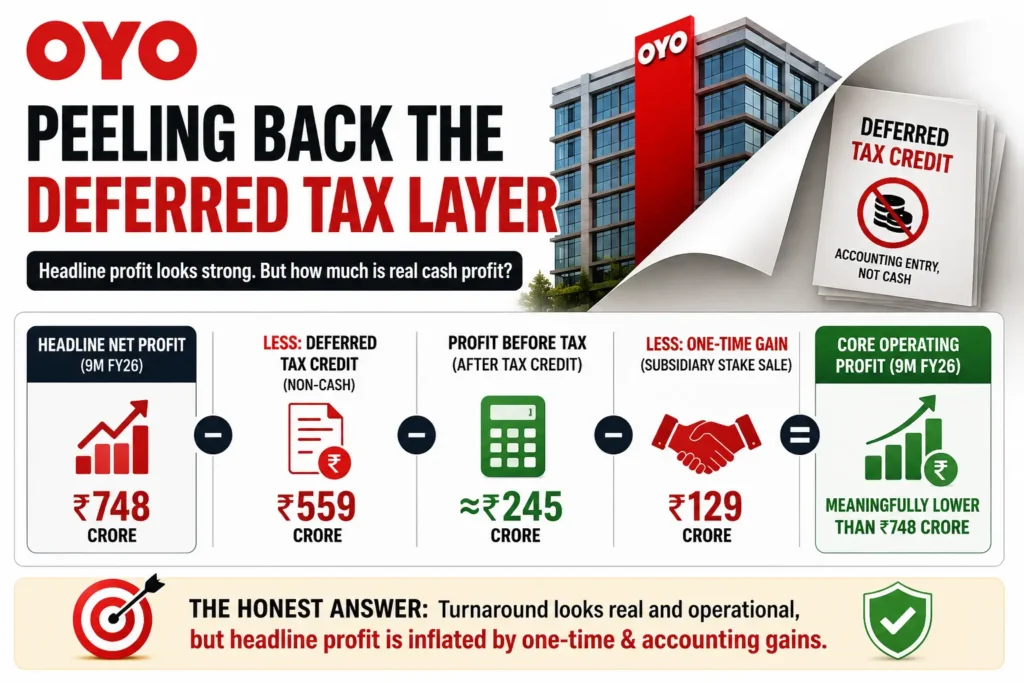
Now let us talk about the number everyone should be paying closer attention to.
A deferred tax credit is an accounting adjustment. Companies get to recognize a tax benefit today for losses or deductions they expect to use later. It does not bring in any actual cash. It simply makes reported profit look bigger on paper.
Here is why this matters so much for OYO. In FY24, the deferred tax gain was small, around ₹51 crore. In FY25, it jumped sharply to about ₹767 crore. And in the first nine months of FY26, it stayed large at roughly ₹559 crore. This is not a one quarter blip. It is a pattern that has repeated across three separate reporting periods.
Now let us do the math properly. Start with the headline profit of ₹748 crore. Subtract the ₹559 crore deferred tax credit, since that is not cash from operations. What you are left with is close to OYO’s actual profit before tax for the period, which comes out to roughly ₹245 crore.
But there is another layer. That ₹245 crore figure itself includes a separate one time gain of about ₹129 crore from selling or reducing its stake in a subsidiary. Strip that out too, and OYO’s core, repeatable operating profit for nine months looks meaningfully smaller than the headline ₹748 crore number suggests. Independent analysis from Finshots’ breakdown of the OYO IPO reaches the same conclusion, treating the ₹245 crore figure as the more reliable read on OYO’s underlying performance.
This is why the honest answer to “is OYO’s PAT sustainable or driven by one time gains” is neither a clean yes nor a clean no. The turnaround looks increasingly operational, but investors need to separate the recurring profit from the one time accounting gains sitting on top of it.
Is the Operational Story Actually Strong?
Here is where things get more interesting, and more balanced.
Even after you remove the one time items, OYO’s underlying business genuinely looks healthier than it did just a couple of years ago. Gross margin expanded from 42.6 percent in FY23 to nearly 61 percent in the first nine months of FY26. That is not an accounting trick. That reflects real changes in how the company earns and spends money.
OYOs Adjusted EBITDA margin is telling a story. The Adjusted EBITDA margin of OYO went from five percent of the revenue in the financial year twenty twenty three to twenty eight point three five percent in the first nine months of the financial year twenty twenty six. This is also the reason why the Adjusted EBITDA of OYO is growing faster than the revenue of OYO. The revenue of OYO is growing at a pace.. The costs of OYO are being controlled even more tightly at the same time. So the operating profitability of OYO is getting bigger faster, than the sales of OYO.
To put this in perspective, look at how OYO compares to some of the biggest names in travel, measured as a percentage of gross booking value, which is the fairer way to compare companies with different business models. OYO’s adjusted EBITDA margin came in at 8.6 percent, ahead of Booking.com at 5.4 percent, Airbnb at 5.0 percent, MakeMyTrip at 2.0 percent, and TBO Tek at 1.1 percent.
A big part of this improvement comes from cost discipline. OYO’s employee costs dropped from around ₹1,548 crore in FY23 to roughly ₹600 to 700 crore from FY24 onward. That is more than half. This was not a small trim. It was a structural cut that reshaped the company’s cost base and it directly supports the margin gains you see today.
So while the headline profit is inflated by tax accounting, the operating business behind it has genuinely gotten leaner and more efficient. This is exactly what “stronger operating performance and improving margins” looks like in practice.
The Premiumization Pivot That Explains More Than the Tax Credit Does
If you really want to understand whether OYO’s business model has changed, this is the section that matters most, and it gets far less attention than it deserves.
Starting in FY24, OYO began rolling out a portfolio of upscale, company managed brands under names like Sunday, Townhouse, Palette, and Clubhouse. The key shift here is not just adding new brand names. It is that OYO started directly managing these properties instead of simply listing independent hotels on an app and hoping for the best.
The scale of this shift is remarkable. In FY24, company managed premium hotels made up just 2.6 percent of OYO’s gross booking value in India. By the first nine months of FY26, that number had jumped to 49.3 percent. Nearly half of OYO’s Indian booking value now comes from properties it actively manages rather than just lists.
This matters because it cuts both ways. Managing properties directly gives OYO more control over pricing, service quality, and guest experience, which supports higher margins. But it also locks the company into higher fixed operating costs. The real question for OYO’s long term sustainability is whether this premium, company managed business can keep growing fast enough to offset those higher costs.
The Risks Almost Nobody Is Talking About
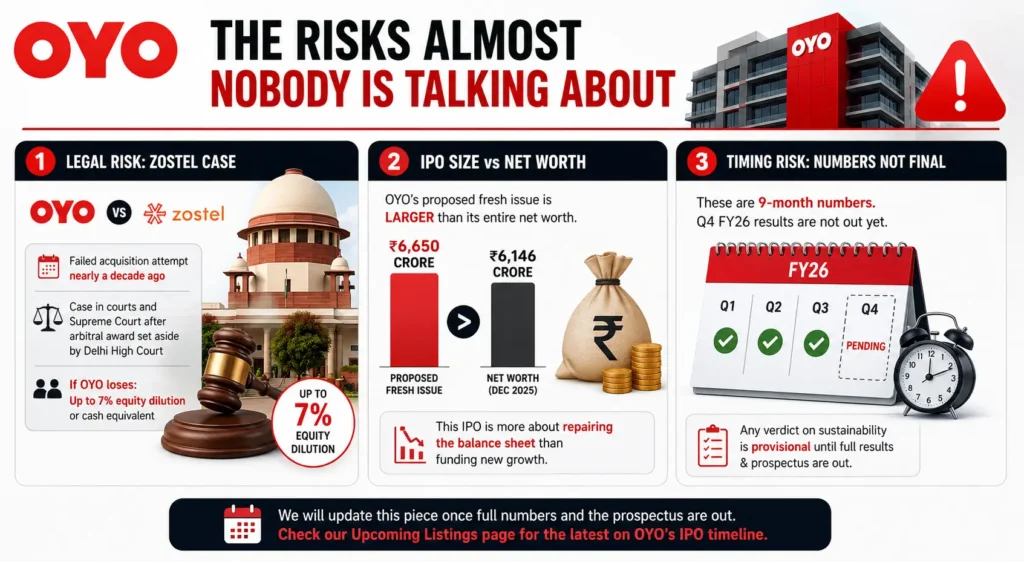
Most coverage of OYO’s profit numbers stops at the accounting story. Very few pieces connect the dots between the profit picture and the risks sitting quietly in the background. Here are the ones that matter.
The first is a legal dispute with Zostel that has dragged on for years. It started when OYO’s attempt to acquire Zostel fell apart nearly a decade ago. Zostel argued OYO backed out of a binding agreement, while OYO maintained that no final contract was ever signed. The case eventually reached the courts and later the Supreme Court after an earlier arbitral award in OYO’s favor was set aside by the Delhi High Court. This case matters to anyone evaluating OYO’s profitability because if the courts rule against OYO in a final order, the company could be required to transfer or issue up to 7 percent of its total equity to Zostel and its partners, or pay the cash equivalent.
The second point worth flagging is the size of the IPO itself compared to OYO’s balance sheet. The proposed fresh issue of ₹6,650 crore is actually larger than OYO’s entire net worth, which stood at around ₹6,146 crore as of December 2025. That is a striking number and it tells you how much this IPO is really about repairing the balance sheet rather than funding new growth.
The third point is simple honesty about timing. These are nine month numbers. OYO has not yet reported its full Q4 FY26 results, so nobody actually knows the full year outcome yet. Any verdict on sustainability right now has to be treated as provisional until the final numbers and the full prospectus are out. We will update this piece once those numbers land, so check our upcoming listings page for the latest on OYO’s IPO timeline.
OYO’s Profit Jump, Explained in Plain Terms
Before getting into the accounting details, here is the short version of what happened and why.
OYO’s PAT improved so sharply in 9MFY26 mainly because of three things working together. Stronger operating performance, higher international revenue, and improving margins drove OYO’s sharp PAT growth. With more than 83 percent of revenue now coming from outside India, largely through the G6 Hospitality business in the US, the company’s topline has simply gotten bigger and more efficient at the same time.
But bigger profit does not automatically mean better profit. Is OYO’s PAT sustainable, or is it driven by one time gains? The honest answer sits in between. The turnaround appears increasingly operational, but investors should distinguish recurring profits from one time accounting gains, since a large chunk of the ₹748 crore headline number came from items that will not repeat every quarter.
One place where the operational story genuinely holds up is EBITDA. Why is OYO’s EBITDA growing faster than its revenue? Because revenue is growing while costs are being controlled, allowing operating profitability to expand faster than sales. This is not an accounting trick, it reflects real cost discipline, particularly the sharp cut in employee expenses since FY23.
Put all of this together and the natural next question is whether OYO has actually become a reliably profitable business, or whether this is a one off good stretch. Is OYO finally a consistently profitable company? Yes, it’s moving in that direction, with margins improving year after year and profits showing up across multiple consecutive reporting periods, though the full picture will only be clear once Q4 FY26 numbers are out.
A Quick Look at How OYO Got Here
OYO’s road to profitability has not been smooth. In FY23, the company posted a loss of ₹1,286 crore. It turned a corner in FY24 with a modest profit of around ₹229 crore, which improved slightly to about ₹245 crore in FY25 on a core basis. Then came the sharp jump in 9M FY26.
This is also OYO’s third attempt at going public, after two earlier IPO filings were withdrawn in 2021 and 2024. The company that is filing now, backed by SoftBank and led by founder Ritesh Agarwal, looks very different from the one that tried and failed twice before. If you want the basics of how the IPO process itself works, our plain language IPO explainers cover terms like DRHP, UDRHP, and price bands in simple language.
The Verdict: Sustainable, One Time, or Somewhere In Between
Here is a simple way to think about it.
Operational improvement looks strong. Margins have genuinely expanded and costs have been meaningfully cut.
Accounting quality looks mixed. A large share of reported profit across three straight periods has come from a deferred tax credit rather than cash operations, along with an additional one time gain in the latest period.
Debt position is improving, but that improvement depends heavily on the IPO succeeding, since most of the proceeds are earmarked for repaying borrowings.
Litigation risk remains unresolved, with a Supreme Court case that could still result in a significant equity dilution.
Put it all together and the honest answer is this. OYO’s operating business really has gotten better, and yes, it does look like it is moving toward becoming a consistently profitable company. But the ₹748 crore headline profit overstates how much of that improvement is happening right now in cash terms. If you want a fair read on where OYO actually stands, look at the roughly ₹245 crore core profit trend, not the headline number, and keep an eye on the risks that are still sitting unresolved in the background.
Frequently Asked Questions
Why did OYO’s PAT improve so sharply in 9MFY26?
Stronger operating performance, higher international revenue, and improving margins drove OYO’s sharp PAT growth. A large part of the jump also came from a ₹559 crore deferred tax credit, which is a non cash accounting benefit rather than operating cash flow.
Is OYO’s PAT sustainable or driven by one time gains?
The turnaround appears increasingly operational, but investors should distinguish recurring profits from one time accounting gains like the deferred tax credit and the subsidiary stake sale gain sitting inside the headline number.
Why is OYO’s EBITDA growing faster than revenue?
Because revenue is growing while costs are being controlled, allowing operating profitability to expand faster than sales. Employee costs alone were cut by more than half between FY23 and FY24 onward.
Is OYO finally a consistently profitable company?
Yes, it is moving in that direction. Margins have expanded every year since FY23 and the company has posted profit in each of the last several reporting periods, though full year FY26 results are still pending.
What is a deferred tax credit and why does it inflate profit?
It is an accounting entry that lets a company record a tax benefit today for deductions it expects to use in the future. It boosts reported profit without bringing in any actual cash.
What risks could affect OYO’s IPO profitability story?
The biggest ones are an unresolved Supreme Court case with Zostel that could force up to 7 percent equity dilution, an IPO size larger than OYO’s current net worth, and the fact that full year FY26 results have not been reported yet.
This analysis is based on publicly available filings and news reports and is meant for informational purposes only. It is not investment advice. Please do your own research or speak with a financial advisor before making any investment decisions related to the OYO IPO.
Conclusion: The Real Story Behind OYO’s Profit
Strip away the headlines, and OYO’s 9MFY26 story comes down to one simple idea. The business is genuinely getting better, but the paperwork is making it look even better than it actually is.
That is not the same as saying the profit is fake. It is not. OYO really did cut its employee costs in half. It really did expand its gross margin from 42.6 percent to nearly 61 percent. It really did build an EBITDA margin that now beats Airbnb, Booking.com, and MakeMyTrip on a like for like basis. None of that happened by accident, and none of it can be explained away by a deferred tax entry.
But the ₹748 crore number on the cover page is not the number that matters. The ₹245 crore hiding underneath it is. That is the figure that tells you what OYO’s actual business, stripped of tax credits and one time asset sales, is capable of earning right now. Everything else is a bonus that investors should enjoy but never rely on.
Here is the real answer to the question that this article was trying to answer. Is OYOs profit going to last? Is it just a one time thing? The answer is that OYOs profit is both. It is going to last. It is also a one time thing, but not in the way the headline says.
The good things that OYO is doing to make money are really. They are getting better every quarter.. The extra money that OYO is getting from accounting is not something that you should expect to happen every year at the same level. OYOs profit is real. The accounting boost, to OYOs profit is not going to happen every year.
For anyone thinking about the IPO, that distinction is not a technicality, it is the entire investment thesis. A company priced on a ₹748 crore profit is a very different bet than a company priced on a ₹245 crore profit. Add in an unresolved Supreme Court case that could still cost OYO up to 7 percent of its equity, and an issue size that is larger than the company’s own net worth, and the picture gets even more nuanced.
OYO spent a decade being known for scale without profit. It may be on its way to becoming known for profit without full transparency about where that profit comes from. The company does not need to hide the deferred tax credit, it is disclosed clearly in the UDRHP for anyone willing to read it. But most headlines will not do that reading for you.
This one did. Now you know exactly which number to trust, which one to treat with caution, and which risks to watch before OYO’s shares actually hit the market. We will update this piece the moment Q4 FY26 numbers and the final RHP are out, so for the latest developments on this IPO and every other listing hitting Indian markets, keep tracking Listing Updates.
About the Author
This piece is written by the Listing Updates editorial desk, covering Indian IPOs, listing day performance, and startup financials in plain English. Every figure in this article is sourced from Oravel Stays Limited’s public UDRHP filing with SEBI, company disclosures, and reporting from established financial publications, with sources linked throughout. Listing Updates is an independent news and information platform, not a SEBI registered investment adviser, and this article does not constitute financial advice. Read our full editorial policy for more on how we source and verify our coverage.