
Table of Contents
Summary
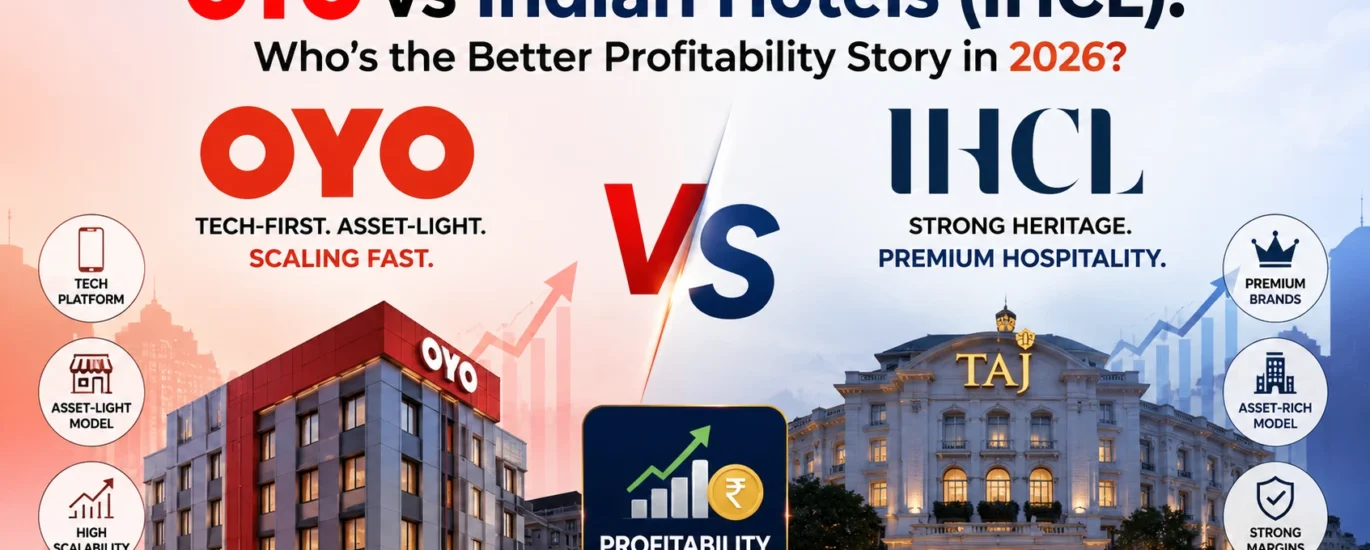
OYO’s parent company Prism is valued at roughly 64 percent of Indian Hotels Company Limited’s market cap, yet earns only a fraction of IHCL’s real profit once one time accounting gains are stripped out. This comparison breaks down both companies across revenue, profit quality, margins, debt, and valuation using audited filings and analyst commentary from Univest, EBC Financial Group, Moody’s, and Nuvama. IHCL wins on consistency, with sixteen straight quarters of record results and a near zero net debt balance sheet. OYO wins on growth rate and international expansion, but its profit still leans on deferred tax credits and one time gains. The verdict: Indian Hotels has a longer track record of consistent profits, while OYO is earlier in its turnaround but growing faster, and its premiumization strategy suggests it is quietly moving toward IHCL’s own playbook.
Key Takeaways
- Prism, OYO’s parent company, is valued at about 64 percent of IHCL’s market cap but earns roughly one eighth of IHCL’s real, clean profit
- IHCL closed FY26 with an audited profit of ₹2,084 crore and its sixteenth consecutive quarter of record performance
- OYO’s real, adjusted profit for 9M FY26 is closer to ₹245 crore once the deferred tax credit and a one time stake sale gain are removed from the ₹748 crore headline figure
- On a straight revenue basis, IHCL’s EBITDA margin of 31 to 37 percent still beats OYO’s adjusted EBITDA margin of 28.35 percent, despite OYO looking stronger when measured against gross booking value instead
- IHCL is close to zero net debt with ₹4,345 crore in gross cash and an AAA+ credit rating, while OYO is using roughly 75 percent of its IPO proceeds to repay existing debt
- Analysts at Univest and EBC Financial Group flag OYO’s path to full PAT profitability and its balance sheet repair as the key risks to watch before the IPO prices
- Moody’s has upgraded OYO’s credit rating citing genuine profitability improvement, while brokerage Nuvama has flagged margin softness and slow renovation returns at some of IHCL’s key properties
- OYO’s CheckIn portfolio of company managed premium hotels grew from 2.6 percent to 49.3 percent of its India booking value in under two years, signaling a shift toward IHCL’s asset heavier, higher control model
- Whether OYO’s eventual $7 to 8 billion IPO valuation is justified depends entirely on whether its recent profitability and international growth can be sustained without relying on further one time accounting boosts
- The overall verdict is that Indian Hotels remains the safer, more proven profitability story, while OYO is the faster growing one, and OYO’s investment case will ultimately come down to the price it lists at
Introduction
OYOs parent company Prism is now valued at sixty four percent of what Indian Hotels Company Limited is worth on the stock market.. When you look at the real profit that Prism makes it is only a small part of what Indian Hotels Company Limited makes. Indian Hotels Company Limited earns a lot money than Prism, about eight times more. The difference, between how much Prism’s worth and how much money it actually makes is the main thing to think about when comparing OYOs parent company Prism and Indian Hotels Company Limited.
So how does OYO’s profitability actually compare with Indian Hotels? In short, Indian Hotels has a longer history of consistent profits, while OYO is earlier in its turnaround but growing at a faster pace. This article breaks that comparison down properly, across revenue, profit quality, margins, debt, valuation, and consistency, using real numbers from both companies’ own filings and independent analyst commentary. By the end, you will also have a clear answer on whether OYO’s expected $7 to 8 billion IPO valuation makes sense, and whether the IPO itself is worth considering as an investment in 2026.
Meet the Two Companies
Indian Hotels Company Limited, known as IHCL, is part of the Tata Group and runs premium brands like Taj and Vivanta. It owns and manages most of its properties directly, which makes it a heavier, more capital intensive business, but also a more predictable one.
OYO, run through its parent company Prism and Oravel Stays, started out as a technology driven, asset light budget hotel platform backed by SoftBank. It is now heading toward its IPO and has been steadily shifting toward managing more premium properties itself, a shift we cover in detail in our breakdown of OYO’s PAT growth in 9MFY26. All financial figures for OYO in this piece are drawn from Oravel Stays Limited’s UDRHP filed with SEBI.
Revenue and Scale: How Close Are They Really
For the full year ending March 2026, IHCL’s consolidated income came in at nearly ₹9,971 crore, up 16 percent year on year. OYO’s revenue from operations for just the first nine months of FY26 was ₹6,941 crore, which works out to an annualized figure of roughly ₹9,255 crore.
That means IHCL is still the bigger company by revenue, but not by much anymore. A few years ago the gap between them was enormous. Today it has narrowed to a difference of less than a thousand crore on an annualized basis. This alone is a reason more people should be asking how these two companies actually compare. You can verify IHCL’s own reported numbers directly through its investor press releases and cross check ongoing figures on Screener’s IHCL company page.
The Profit Quality Gap: Clean Earnings vs Adjusted Earnings
Here is where the real difference between these two companies starts to show up.
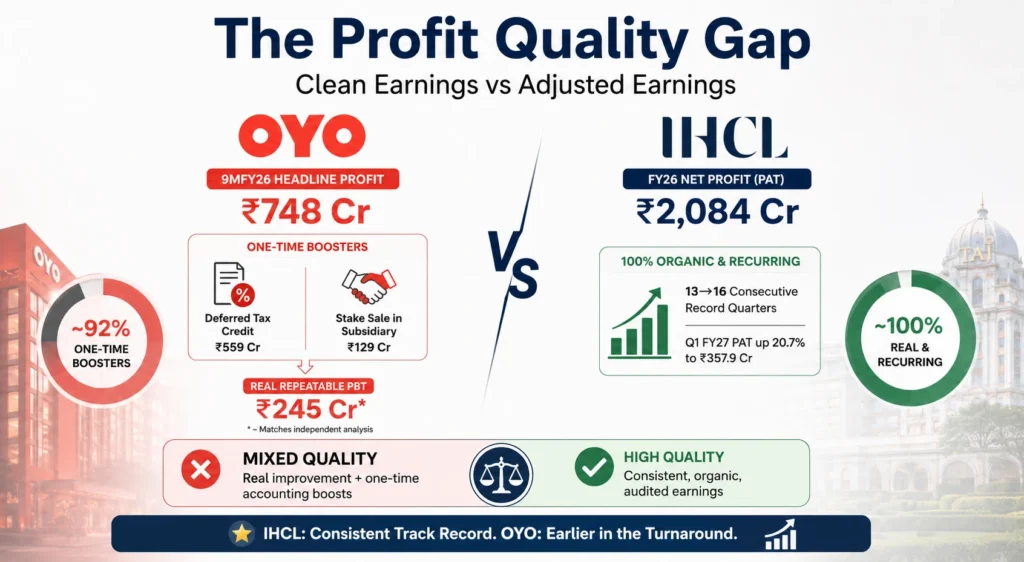
IHCL closed FY26 with a record profit after tax of ₹2,084 crore. This is a fully audited, organically earned number. There is no deferred tax boost inflating it and no one time asset sale hiding inside it. It is simply the result of running hotels well, quarter after quarter. In fact, management called the first quarter of FY26 the thirteenth straight quarter of record performance, and by the fourth quarter that streak had extended to sixteen consecutive record quarters. The momentum continued into the new fiscal year too, with Q1 FY27 net profit rising 20.7 percent to ₹357.9 crore.
OYO’s headline profit for the first nine months of FY26 was ₹748 crore. That number gets a lot of attention because it looks like a dramatic turnaround. But as we explained in our full breakdown of OYO’s PAT growth in 9MFY26, nearly ₹559 crore of that profit came from a deferred tax credit, a non cash accounting entry, and another ₹129 crore came from selling a stake in a subsidiary. Strip both of those out and OYO’s real, repeatable profit before tax for the same period drops to around ₹245 crore, a figure that closely matches independent analysis of the same numbers by Finshots.
Put simply, IHCL’s profit is almost entirely real and recurring. OYO’s profit is a mix of real operational improvement and one time accounting boosts. Neither company is doing anything wrong or hiding anything illegal, but if you are comparing quality of earnings, IHCL wins this round clearly. This is exactly what it means to say Indian Hotels has a longer history of consistent profits while OYO is still earlier in its turnaround.
Margins: Who Actually Runs the Tighter Business
This is the section where a lot of existing coverage quietly gets things wrong, and it is worth slowing down here.
You may have seen OYO’s margins compared favorably against companies like Airbnb and Booking.com. Those comparisons measure OYO’s EBITDA margin against gross booking value, a metric that fits how OYO’s asset light model works. On that basis, OYO looks very strong.
. Ihcl does not show its margins in that way. It shows EBITDA as a percentage of revenue the way most listed hospitality companies do. On that basis IHCLs EBITDA margin for FY26 was between 31 and 37 percent depending on the quarter. OYOs adjusted EBITDA margin, for the nine month period was 28.35 percent of revenue.
So when you measure both companies the same way, on straight revenue, IHCL is still ahead on margins. This does not mean OYO is doing badly. It means OYO’s margin story has been told using a metric that makes it look better than it does when compared directly to IHCL. Being upfront about this is exactly the kind of detail that most quick comparison pieces skip.
Balance Sheet and Debt: Repairing vs Optimizing
IHCL has a strong balance sheet. It ended FY26 with cash of ₹4,345 crore, a pre-tax return on capital employed of 17 percent, and a credit rating upgrade to AAA+ from ICRA, all detailed in its FY26 full year results announcement. The company has clearly stated it wants to become a zero debt business, and it is already close to that goal.
OYO’s position looks very different. A large share of its upcoming IPO proceeds, roughly 75 percent, is earmarked specifically to repay existing debt, a structure examined in detail in EBC Financial Group’s breakdown of the PRISM IPO. This is not a red flag by itself, plenty of companies use IPO proceeds this way, but it does tell you something important. IHCL is polishing an already clean balance sheet. OYO is still in the process of cleaning one up.
Is OYO’s $7 to 8 Billion Valuation Justified
This is probably the question on most investors’ minds, and the honest answer is that it depends on whether investors believe its recent profitability and global growth can be sustained.
IHCL currently trades at a price to earnings ratio somewhere between 49 and 75 times, which is already rich compared to a premium peer like EIH, the company behind Oberoi and Trident hotels, which trades closer to 28 to 35 times earnings, according to reporting on IHCL’s valuation versus its peers. That tells you the market has already priced in a lot of future growth for IHCL, which means the stock has real room to fall if that growth slows even slightly.
OYO’s parent Prism has been valued even more aggressively. Its valuation jumped 107 percent in a single year to reach ₹67,200 crore, making it the biggest gainer in the entire hospitality sector on the latest Hurun India Real Estate 150 list. Before that jump, OYO’s unlisted shares had reportedly traded at a price to earnings multiple as high as 150 to 160 times.
More than 83 percent of OYO’s revenue now comes from international markets, largely through its US business built around the G6 Hospitality acquisition. If that international growth keeps compounding and the company’s margin improvement continues without leaning as heavily on deferred tax credits, the $7 to 8 billion valuation becomes much easier to justify. If growth slows or the accounting boosts fade without being replaced by real operating gains, the valuation will look stretched very quickly. That single condition, sustainability of both profitability and global growth, is really the whole valuation debate in one sentence.
Consistency and Track Record
IHCL’s biggest advantage may simply be time. Sixteen consecutive quarters of record performance is not a small achievement. It shows a business that keeps delivering, quarter after quarter, without needing a dramatic turnaround story to explain it.
OYO’s consistency story is much younger. The company only became reliably profitable starting in FY24, and its most impressive numbers are concentrated in the last few quarters. That does not make the story less real, but it does make it less proven. Investors who value predictability will naturally lean toward IHCL. Investors who value momentum and growth rate will lean toward OYO, since it is growing at a noticeably faster pace even while it is still earlier in its turnaround.
Is OYO Quietly Becoming the Next IHCL
Here is the most interesting part of this whole comparison, and it is something almost nobody else is talking about.
OYO built its entire early identity around being asset light, a technology platform that listed other people’s hotels rather than running them directly. But that is changing fast. OYO’s CheckIn portfolio of company managed premium brands, including Sunday, Townhouse, Palette, and Clubhouse, has grown from just 2.6 percent of its India gross booking value in FY24 to 49.3 percent by the first nine months of FY26.
That is nearly half of OYO’s Indian business now running on a model that looks a lot more like IHCL’s, direct control over pricing, service quality, and guest experience, in exchange for higher fixed costs. In other words, the company that once defined itself as the opposite of IHCL is now quietly moving toward IHCL’s own playbook. The real question is not just who wins today. It is whether OYO can execute this shift well enough to eventually earn IHCL level margins on IHCL level consistency.
Scorecard: OYO vs IHCL at a Glance
Revenue scale goes to IHCL, though the gap is closing fast.
Profit quality goes to IHCL, since its earnings are fully organic while OYO’s still carry one time boosts.
Margins on a like for like revenue basis go to IHCL.
Balance sheet strength goes to IHCL, with its cash position and improving credit rating.
Valuation risk is high on both sides, IHCL because of its rich multiple, OYO because of its unproven multiple ahead of listing.
Growth momentum and consistency of improvement goes to OYO, which has shown the sharpest year on year gains in the sector.
Put together, Indian Hotels has a longer history of consistent profits, while OYO is earlier in its turnaround but growing at a faster pace. That single sentence captures the entire comparison better than any individual number can.
Case Studies
Case Study 1: The 2022 fake accounting controversy and how OYO responded
When OYO first claimed positive adjusted EBITDA in 2022, former Infosys director T.V. Mohandas Pai publicly called it fake accounting on social media, arguing there is no such thing as adjusted EBITDA and accusing the company of misleading investors. OYO’s Group CFO responded directly, pointing out that EBITDA was clearly reported at a higher figure than the adjusted number being criticized, and that all figures came from audited, signed financial statements. This exchange is a useful real world case study in why terminology matters. It shows that scrutiny of OYO’s numbers isn’t new, and that the company has a track record of being challenged publicly and responding with its filings rather than backing away from its claims.
Case Study 2: IHCL’s Ahvaan 2025 strategy and what it actually delivered
In 2022, IHCL laid out its Ahvaan 2025 plan, targeting a 300 hotel portfolio, a 33 percent EBITDA margin, and a shift toward becoming a zero net debt company, with management fees and new businesses expected to contribute 35 percent of EBITDA. By FY26, IHCL had delivered close to this, posting a 34.9 percent EBITDA margin for the full year and a 37 percent margin in the fourth quarter alone, alongside a gross cash position of ₹4,345 crore. This is a rare example in Indian hospitality of a multi year public strategy target being largely met on schedule, and it is a big part of why IHCL commands the consistency premium discussed earlier in this article.
Case Study 3: OYO’s premiumization bet, from 2.6 percent to 49.3 percent of India GBV
Between FY24 and the first nine months of FY26, OYO’s company managed premium portfolio, branded as CheckIn and including Sunday, Townhouse, Palette, and Clubhouse, grew from 2.6 percent to 49.3 percent of its India gross booking value. This is effectively a live case study in a company changing its own business model mid flight, moving from a pure asset light aggregator toward something closer to IHCL’s owned and operated approach. Whether this bet pays off in higher, more durable margins over the next few years will likely determine whether OYO can eventually close the profitability gap with IHCL discussed throughout this piece.
Expert and Analyst Opinions
Analysts covering OYO’s IPO from Univest have noted that OYO has demonstrated its asset light aggregator model can generate meaningful operating leverage, with positive EBITDA of around ₹801 crore in FY25, but flagged that the most important metric for public market investors will be the path to full PAT profitability, since legacy debt servicing costs have historically kept the company at a net loss even after turning EBITDA positive.
EBC Financial Group’s analysis of the IPO structure points to a specific risk worth taking seriously, noting that the offer has no offer for sale component and stronger profitability, but that most proceeds are directed toward repaying borrowings, so a high price band would leave less room for debt reduction, acquisition integration, and managing profit durability risk. In other words, the analysts are flagging exactly the tension this article has walked through, a company still repairing its balance sheet being asked to price like one that has already finished repairing it.
On the ratings side, credit agency Moody’s has upgraded OYO’s credit rating, citing the company’s improved profitability over recent quarters, an independent, third party validation that the underlying operating improvement is being taken seriously by institutions that specialize in assessing exactly this kind of question.
On IHCL’s side, brokerage Nuvama has flagged a more cautious note, pointing out that renovations at key properties including Taj Palace, Taj President, and Fort Aguada have yet to produce a visible performance lift, and that flat EBITDA margins in one recent quarter, despite revenue growth, suggest possible cost management challenges. This is a useful reminder that even the more consistent of these two companies isn’t without its own scrutiny points, and it keeps this comparison honest rather than one sided.
Taken together, the expert view broadly lines up with the theme of this article. IHCL is respected for consistency but is being watched for execution risk on its own expansion. OYO is being credited for real operating improvement but is being watched closely on whether that improvement can survive without the accounting boosts and debt overhang that still shape its numbers today.
Will the OYO IPO Be a Good Investment in 2026
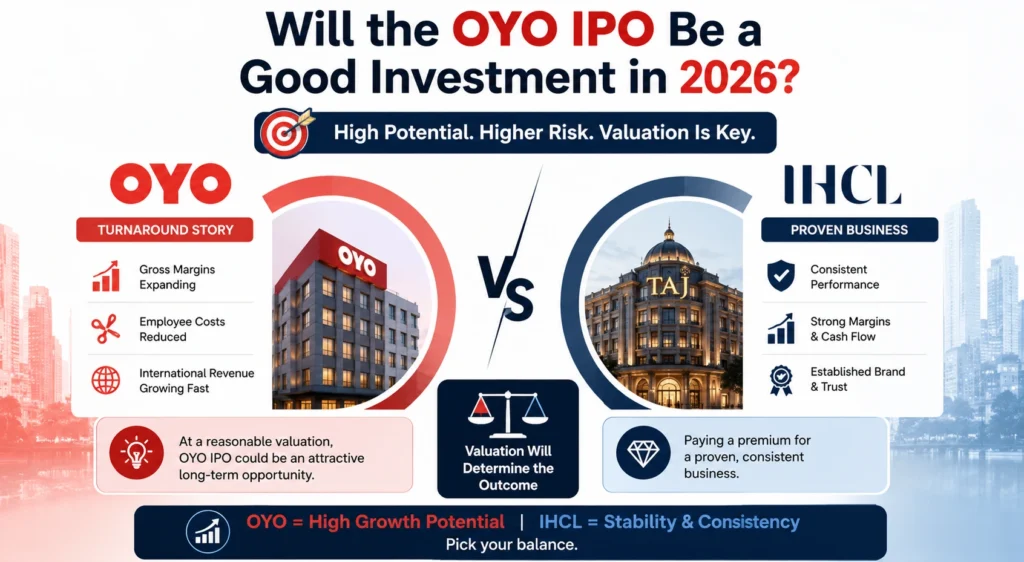
This is the question every reader ultimately wants answered, and the honest answer is that if OYO sustains its financial turnaround and lists at a reasonable valuation, it could be an attractive long term opportunity, but execution and valuation will be key.
The turnaround itself looks increasingly real, gross margins have genuinely expanded, employee costs have been meaningfully cut, and international revenue continues to grow at a fast clip. But the price you pay matters just as much as the story you are buying into. If OYO lists at a valuation that already assumes years of flawless execution, there is very little room for error. If it lists at a more reasonable multiple that leaves room for the turnaround to keep proving itself quarter by quarter, the risk to reward balance looks much better for investors. Compare that to IHCL, where you are paying a rich price for a proven, consistent business rather than a promising but younger one.
Frequently Asked Questions
How does OYO’s profitability compare with Indian Hotels?
Indian Hotels has a longer history of consistent profits, while OYO is earlier in its turnaround but growing at a faster pace. IHCL is now on its sixteenth consecutive quarter of record performance, while OYO only became reliably profitable starting FY24, but its year on year improvement in margins and revenue has outpaced IHCL’s steadier growth curve.
Is OYO’s $7 to 8 billion valuation justified?
It depends on whether investors believe its recent profitability and global growth can be sustained. More than 83 percent of OYO’s revenue now comes from international markets, and if that momentum continues alongside genuine margin improvement rather than one time accounting gains, the valuation becomes easier to justify over time.
Will the OYO IPO be a good investment in 2026?
If OYO sustains its financial turnaround and lists at a reasonable valuation, it could be an attractive long term opportunity, but execution and valuation will be key. Investors should watch whether the company’s real, adjusted profit keeps growing after the deferred tax boosts fade, and whether the IPO is priced in line with that underlying performance rather than the headline numbers.
Which has better margins, OYO or IHCL?
On a straight revenue basis, IHCL’s EBITDA margin of 31 to 37 percent is ahead of OYO’s adjusted EBITDA margin of 28.35 percent. OYO only looks stronger when margins are measured against gross booking value instead.
How does OYO’s debt compare to IHCL’s balance sheet?
IHCL is close to becoming a zero net debt company with a strong cash position and an AAA+ credit rating. OYO is still repaying debt, with roughly 75 percent of its IPO proceeds earmarked for that purpose.
Conclusion
IHCL and OYO are telling two very different kinds of profitability stories right now. IHCL’s story is about consistency, sixteen straight quarters of record results, a clean balance sheet, and profit that needs no asterisks. OYO’s story is about momentum, a business that has genuinely improved its operations while still leaning on some accounting boosts to make its headline numbers look bigger than they are.
Neither story is finished being written. IHCL still has to prove its rich valuation is worth paying for. OYO still has to prove its premiumization pivot can turn its improving operations into IHCL level earnings quality, and that its eventual IPO price leaves enough room for that story to keep playing out. For now, Indian Hotels remains the more reliable profitability story, while OYO remains the faster growing one, and whether OYO turns out to be a good investment in 2026 will come down almost entirely to the price it lists at.
For more comparisons like this and ongoing coverage of the OYO IPO as new numbers come in, keep following Listing Updates.
This analysis is based on publicly available company filings, investor presentations, and news reports, and is meant for informational purposes only. It is not investment advice. Please do your own research or speak with a financial advisor before making any investment decisions involving either company.