
Table of Contents
Summary
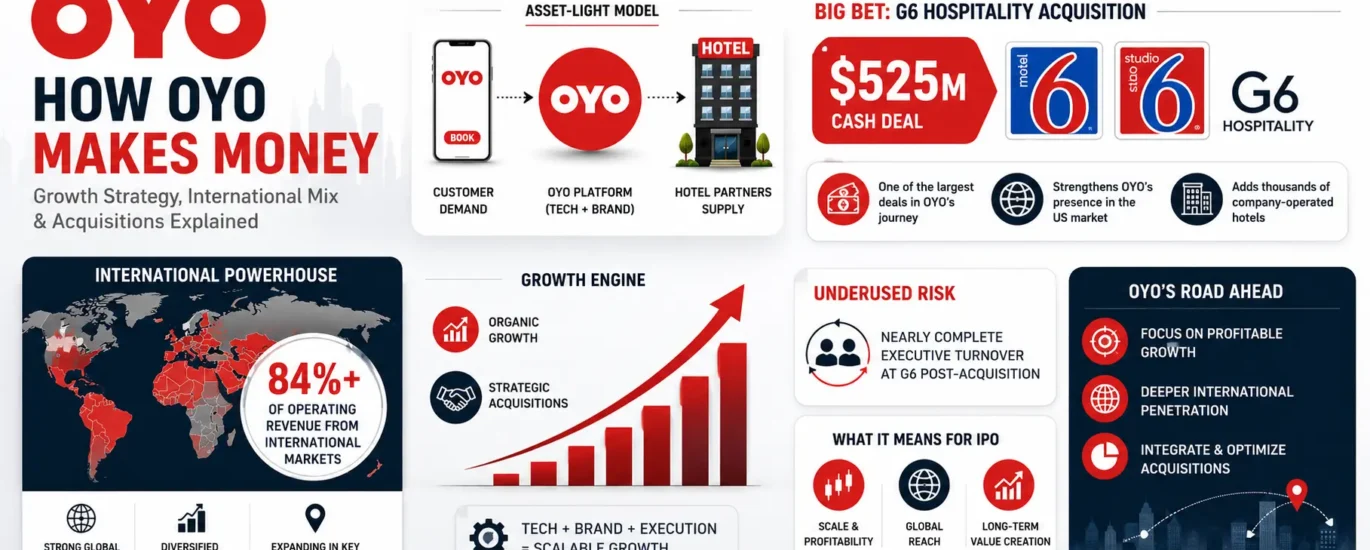
OYO built its reputation as an asset light aggregator, yet its parent company spent $525 million in cash to acquire Motel 6 and Studio 6 through the G6 Hospitality deal, a genuine contradiction worth examining. This article breaks down how OYO actually makes money in 2026, confirming its growth is both organic and acquisition driven, backed by real case studies including Blackstone’s own comments on the deal and founder Ritesh Agarwal’s public defense of the price. More than 84 percent of OYO’s operating revenue now comes from international markets, largely driven by this US expansion. The piece also flags an underused risk, G6’s near complete executive turnover post acquisition, and explains what this growth strategy means for OYO’s upcoming IPO.
Key Takeaways
- OYO’s growth is genuinely both organic and acquisition driven, organic expansion continues through new franchise signings and its CheckIn premium portfolio, while acquisitions like G6 Hospitality have accelerated global growth
- More than 84 percent of OYO’s operating revenue now comes from international markets, with ₹5,814 crore from international markets versus just ₹1,127 crore from India in 9M FY26
- OYO’s parent company paid $525 million in an all cash deal to acquire G6 Hospitality, the parent of Motel 6 and Studio 6, from Blackstone Real Estate, a deal that closed in December 2024
- The acquisition is projected to push OYO’s EBITDA past ₹2,000 crore by FY26, with Motel 6 alone expected to contribute more than ₹630 crore of EBITDA in its first full year
- A company long defined as asset light just directly acquired a 1,500 property hotel franchise business outright, suggesting OYO’s strategy may be quietly shifting toward a more hybrid, owner operator model
- G6 Hospitality saw a near complete executive turnover immediately after the acquisition, including its CEO, CFO, and several other top leaders, a genuine integration risk that most coverage of the deal overlooks
- Blackstone’s own leadership called the sale a terrific outcome for investors, having more than tripled its capital and earned over $1 billion in profit since buying G6 for $1.9 billion in 2012, indicating OYO paid a fair, not discounted, price
- Founder Ritesh Agarwal publicly defended the $525 million price tag, arguing critics underestimated G6’s actual earnings power and the brand’s loyal franchisee base
- OYO’s 2019 acquisition of DanCentre, a European vacation rental company, nearly tripled in EBITDA post acquisition according to OYO’s own M&A leadership, proving the company can grow what it buys, not just acquire scale
- OYO’s international revenue growth and acquisition strategy are central to its IPO story, directly supporting the profitability and margin improvements covered in the company’s broader financial turnaround
Introduction
OYO built its entire identity around one idea. It does not own hotels, it partners with them. So it might surprise you to learn that OYO’s parent company recently spent $525 million in cash to buy one of America’s most recognizable hotel chains outright. That single deal tells you more about how OYO actually makes money today than any old business model explainer floating around online.
So how does OYO really make its money in 2026, is its growth organic or bought, and does it even earn most of its revenue from India anymore? This article provides answers to all three questions using numbers. The numbers come directly from company reports announcements, about buying companies and statements made by OYOs own bosses. It doesn’t use commission rates or the loss numbers that were around before the company changed things. Most other articles still use those numbers.
How OYO’s Revenue Model Actually Works Today
At its core, OYO still earns money the way it always has, through commissions on hotel bookings made through its platform, along with franchise and royalty fees from hotels that carry the OYO brand. On top of that, the company earns from ancillary services like its Wizard membership program, value added services, and increasingly, revenue from properties it manages directly rather than just lists.
That last part matters a lot right now. As we covered in our comparison of OYO against Indian Hotels, OYO’s company managed premium portfolio, branded as CheckIn, has grown from a tiny sliver of its India business to nearly half of it in under two years. This means a meaningful and growing share of OYO’s revenue today comes from properties it runs directly, not just properties it lists for a cut of the booking.
If you have read older articles about how OYO makes money, many of them still describe a flat 22 percent commission model and mention the company being deep in losses. Neither of those pictures reflects where the business actually stands today. OYO turned profitable starting FY24, and its revenue mix has shifted meaningfully since then, something we broke down fully in our piece on OYO’s PAT growth in 9MFY26.
Is OYO Growing Organically or Mainly Through Acquisitions
This is one of the most common questions people ask about OYO, and it deserves a clear, direct answer rather than a vague one.
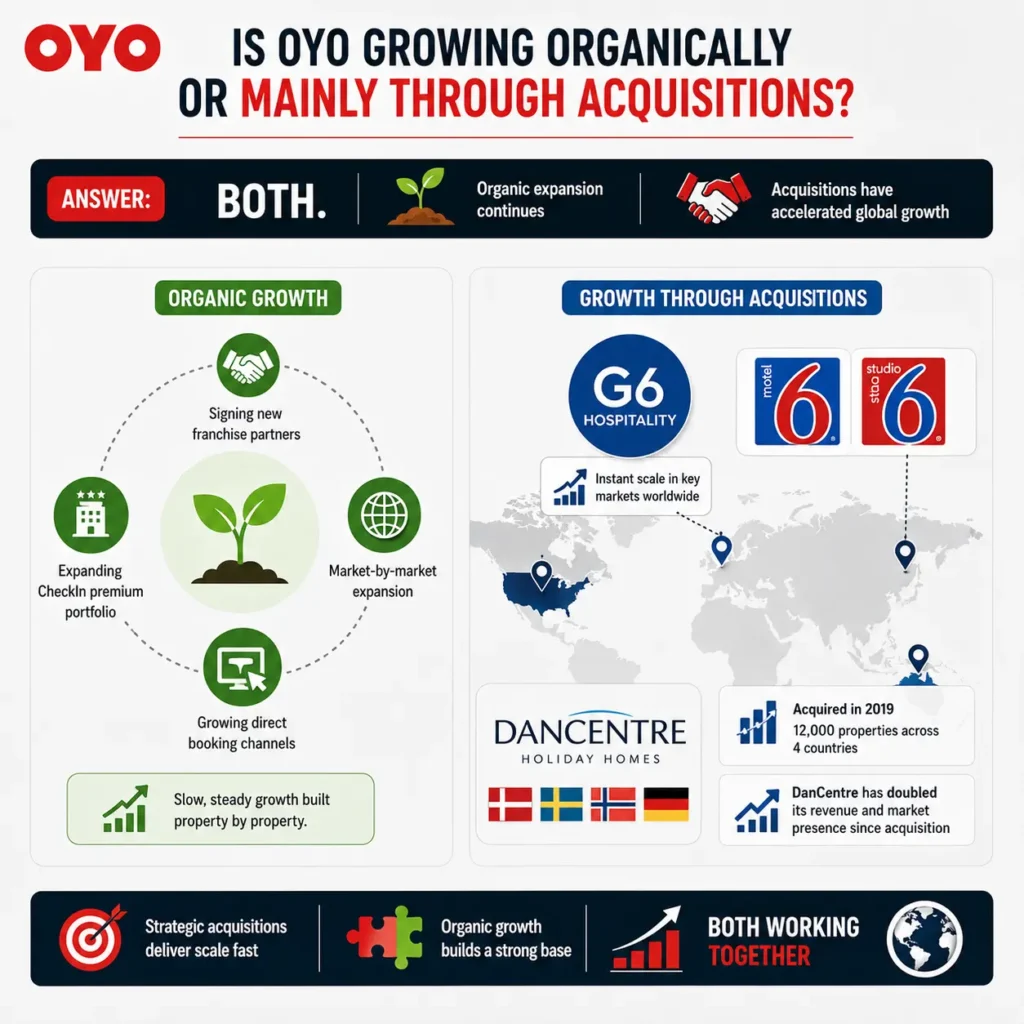
Both. Organic expansion continues, while acquisitions like G6 Hospitality have accelerated global growth.
On the organic side, OYO keeps signing new franchise partners, growing its CheckIn premium portfolio market by market, and expanding its own direct booking channels. This is slow, steady growth built property by property, and it does not make headlines the way a big acquisition does, but it is the foundation the rest of the business sits on.
On the acquisition side, OYO has made a small number of large, strategic purchases that instantly added scale in markets where building from scratch would have taken years. The biggest of these by far is the G6 Hospitality deal, which we will break down in detail below. But it is not OYO’s first acquisition. Back in 2019, OYO acquired DanCentre, a vacation home management company overseeing 12,000 properties across Denmark, Sweden, Norway, and Germany, and OYO has stated that DanCentre has doubled both its revenue and its market presence since being acquired. That is real evidence that OYO does not just buy growth, it can actually grow what it buys, and it is the clearest possible answer to whether OYO’s expansion is organic or acquired. It is genuinely both, working together.
The Asset Light Contradiction Nobody Is Talking About
Here is something almost no other article about OYO’s business model points out clearly.
For over a decade, OYO defined itself as an asset light company. It did not own hotels, it partnered with independent owners, provided them technology and branding, and took a cut of the bookings. That model kept OYO’s balance sheet light and its expansion fast.
Then, in September 2024, OYO’s parent company agreed to pay $525 million in cash to directly acquire G6 Hospitality, the parent company of Motel 6 and Studio 6, outright. That is not a partnership. That is ownership, at scale, in the middle of America’s biggest hospitality market.
This is worth sitting with for a moment. The company that built its reputation on not owning real estate just wrote one of the largest checks in its history to own a real estate heavy franchise business directly.
Combined with the CheckIn premiumization push in India, where OYO now directly manages nearly half of its premium India portfolio, a real pattern starts to emerge. OYO’s strategy may be quietly shifting from a purely asset light aggregator toward something closer to a hybrid owner operator, more similar to how a company like Indian Hotels runs its business than OYO’s original playbook ever was.
Inside the G6 Hospitality and Motel 6 Acquisition
This deal deserves its own detailed look, because it is the single biggest driver of OYO’s recent growth story.
In September 2024, OYO’s parent company Oravel Stays agreed to acquire G6 Hospitality from Blackstone Real Estate for $525 million in an all cash transaction. G6 is the franchisor behind the Motel 6 and Studio 6 brands, with a network of roughly 1,500 properties spread across the United States and Canada. At the time, Motel 6’s franchise network was generating gross room revenue of $1.7 billion, giving G6 a strong existing fee base and steady cash flow before OYO even took over.
The deal officially closed in December 2024. Once combined, the two businesses were expected to generate a total gross booking value of around $3 billion, with G6 Hospitality alone contributing about $1.7 billion of that figure. On the profit side, the acquisition was projected to push OYO’s overall EBITDA past ₹2,000 crore by FY26, with Motel 6 alone expected to contribute more than ₹630 crore of EBITDA in its very first full year under OYO’s ownership.
So was $525 million a fair price? Motel 6 can make a lot of money on its own over ₹630 crore which’s around 75 million dollars, every year. This is the beginning as OYO adds its technology and pricing tools to Motel 6 the money Motel 6 makes will grow. So when we think about how it will take to get the money back from this deal it does not seem that long, just a few years. This is a way to think about the deal rather, than just looking at how much OYO paid for Motel 6 which is what most people are talking about.
The Risk Nobody Mentions: G6’s Leadership Turnover
Most articles that cover this acquisition stop at the excitement of the deal itself. Very few mention what happened inside G6 immediately afterward, and it is worth knowing before you form a full picture of this growth story.
As part of the transition, several of G6’s top executives left the company almost immediately, including its former president and CEO, chief brand officer, general counsel, chief financial officer, chief human resources officer, and chief information officer. OYO brought in new leadership, including a new CEO, to run the business going forward.
This is not necessarily a red flag. Leadership changes are common after large acquisitions. But a near complete executive turnover at a business with 1,500 franchised properties is a genuine integration risk worth watching, not something to gloss over. How smoothly new leadership manages relationships with existing Motel 6 franchisees over the next couple of years will say a lot about whether this acquisition delivers on its promised numbers.
Case Studies
Case Study 1: The DanCentre acquisition and OYO’s own words on why it worked
OYO’s own leadership has pointed directly to its earlier European acquisition as proof that its playbook works. Ankit Tandon, OYO’s Global Chief Business Officer and Head of M&A, said the company’s success in Europe, where it nearly tripled EBITDA through strategic synergies for its vacation homes business, gave OYO a clear roadmap for value creation before it went on to acquire G6 Hospitality. This is a genuinely useful case study because it is not outside speculation, it is OYO’s own M&A leadership explaining why they believed the much larger Motel 6 deal would work, based on a smaller deal that they already had.
Case Study 2: Why Blackstone sold, and what that tells you about the price OYO paid
Blackstone had originally bought G6 Hospitality, the company behind Motel 6, from Accor for $1.9 billion back in 2012. By the time it sold the business to OYO for $525 million in 2024, Rob Harper, head of Blackstone Real Estate Asset Management Americas, said the firm had more than tripled its investors’ capital and generated over $1 billion in profit over its holding period, calling the OYO deal a terrific outcome for investors. This case study matters because it shows the $525 million price tag was not a distressed sale, Blackstone walked away highly profitable, which means OYO paid a price the seller was genuinely happy with, not a discounted, desperate one.
Case Study 3: Founder Ritesh Agarwal’s own defense of the deal price
At an industry conference, OYO founder Ritesh Agarwal directly addressed early skepticism about the $525 million price tag. He pointed out that people reacting with surprise at “just half a billion” did not know G6’s actual earnings and EBITDA, and argued the Motel 6 and Studio 6 brands were genuinely worth more than that based on their earnings power and the loyalty of their franchisees. He also credited Blackstone with having done an exceptional job transforming the business into a fully franchised, asset light operation before OYO took over. This is a rare instance of a founder publicly defending a valuation with specifics rather than just marketing language, which adds real credibility to the deal’s logic.
Expert and Industry Opinions
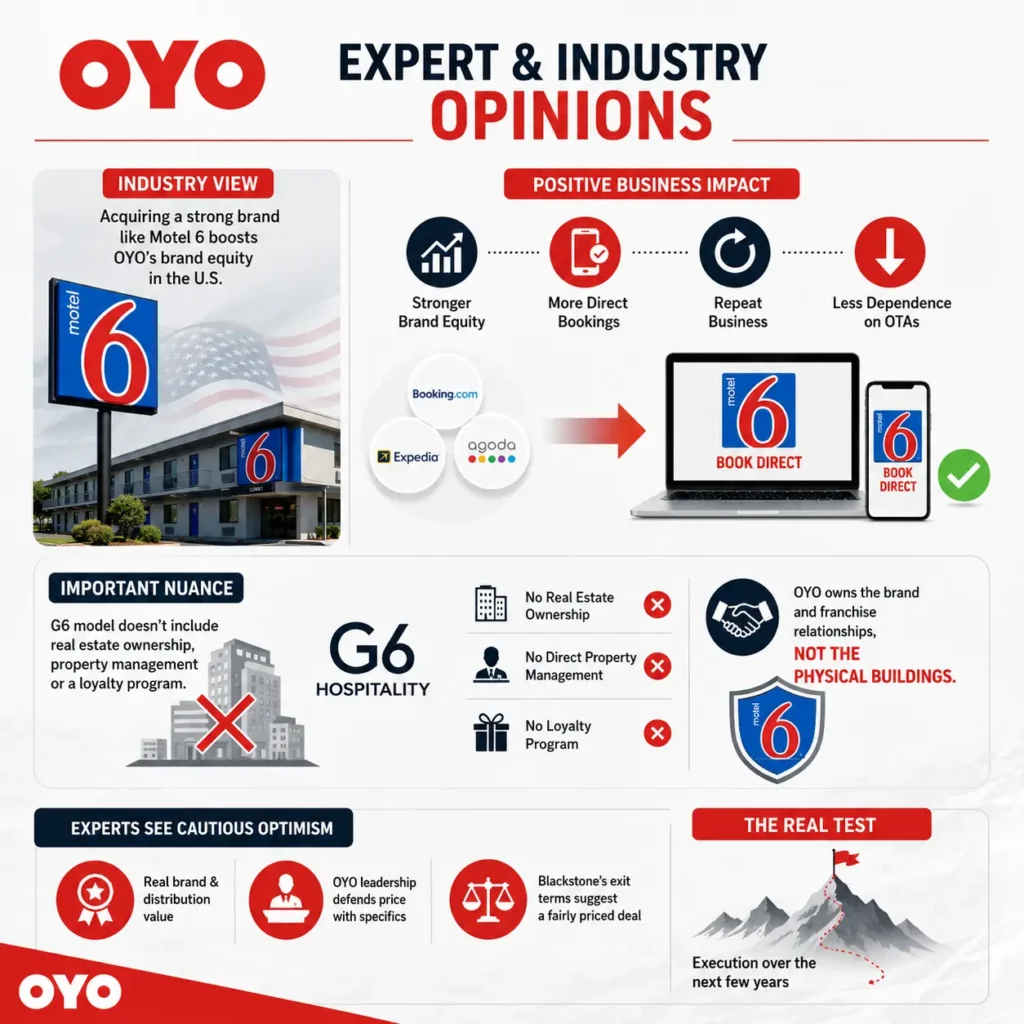
Industry hospitality consultant Max Starkov noted that acquiring a well known hotel chain like Motel 6, with strong brand recognition, would undoubtedly help OYO increase its brand equity in the U.S., in turn helping increase direct bookings and repeat business while decreasing dependency on third party booking platforms. This is a meaningful outside validation of OYO’s own stated strategy of shifting Motel 6’s bookings toward direct channels to improve margins.
At the same time, coverage of the deal has noted an important nuance worth flagging honestly. The G6 model OYO inherited does not come with real estate ownership, direct property management, or even a loyalty program, since G6 itself never built one. This means OYO’s Motel 6 business remains a franchise fee business at its core, even under new ownership, which tempers some of the “OYO now owns hotels” framing with a more accurate picture, OYO owns the brand and the franchise relationships, not the physical buildings themselves.
Taken together, the expert commentary around this deal paints a picture of cautious optimism. Industry voices see real brand and distribution value in the acquisition, OYO’s own leadership has defended the price with specifics, and Blackstone’s exit terms suggest the deal was priced fairly rather than opportunistically low. The real test, as with any acquisition, will be execution over the next few years.
Beyond G6: What OYO’s Other Acquisitions Prove
The DanCentre acquisition mentioned earlier is the best evidence available that OYO’s growth by acquisition strategy is not just about buying bigger numbers. It is about OYO’s ability to actually run what it buys better than the previous owner did. A vacation rental business that nearly triples its EBITDA after being folded into OYO’s technology and distribution network is a genuine success story, even if it gets far less attention than the much larger Motel 6 deal.
Taken together, DanCentre and G6 Hospitality show a consistent pattern. OYO tends to buy established brands with real existing revenue, then apply its technology, pricing, and distribution tools to grow them further, rather than buying distressed assets and hoping for a turnaround.
Does OYO Earn More Revenue Outside India Than In India
This is the second question worth answering directly and clearly.
Yes, more than 84 percent of OYO’s operating revenue now comes from international markets.
For the first nine months of FY26, OYO earned roughly ₹5,814 crore from international markets, compared to just ₹1,127 crore from India. That is a striking number if you still think of OYO primarily as an Indian budget hotel company, because the reality today is closer to the opposite. OYO now earns the overwhelming majority of its money from outside India, and the Motel 6 and Studio 6 business acquired through the G6 deal is one of the biggest reasons why.
This is genuinely one of the most surprising facts about OYO’s current business, and it is worth remembering the next time you see OYO described purely as an Indian hospitality startup.
Where OYO Operates Today
OYO’s footprint today spans more than 184,000 properties across over 35 countries, including India, the United States, the United Kingdom, continental Europe, Southeast Asia, and West Asia. Two acquisitions did more to expand this global footprint than almost anything else in the company’s history, DanCentre in Europe back in 2019, and G6 Hospitality in North America more recently. Between them, these two deals turned OYO from a company with a strong India base and modest international presence into a genuinely global hospitality platform.
What This Growth Story Means for OYO’s IPO
All of this connects directly to the bigger picture around OYO’s upcoming IPO. The international revenue growth and the G6 acquisition are two of the biggest reasons behind the margin and revenue improvements we detailed in our breakdown of OYO’s PAT growth in 9MFY26, and they are also central to how OYO’s growth story compares against a more established player like IHCL, which we covered in our full OYO vs Indian Hotels profitability comparison. Investors evaluating the IPO should think of OYO’s growth strategy, organic expansion plus targeted, well integrated acquisitions, as a core part of the profitability story, not a separate footnote to it.
Frequently Asked Questions
Is OYO growing organically or mainly through acquisitions?
Both. Organic expansion continues, while acquisitions like G6 Hospitality have accelerated global growth. DanCentre in 2019 and G6 Hospitality more recently show that OYO’s acquisitions tend to grow further once integrated, rather than simply adding one time scale.
Does OYO earn more revenue outside India than in India?
Yes, more than 84 percent of OYO’s operating revenue now comes from international markets. For 9M FY26, international markets contributed ₹5,814 crore compared to ₹1,127 crore from India.
How much did OYO pay for Motel 6?
OYO’s parent company paid $525 million in an all cash deal to acquire G6 Hospitality, the parent company of Motel 6 and Studio 6, from Blackstone Real Estate. The deal closed in December 2024.
What other companies has OYO acquired?
Beyond G6 Hospitality, OYO’s most notable acquisition is DanCentre, a European vacation home management company acquired in 2019 that OYO’s own leadership says nearly tripled in EBITDA since being acquired.
Is OYO still an asset light company?
Not entirely. While its original franchise and commission model remains central to its business, OYO’s direct ownership of G6 Hospitality and its growing company managed premium portfolio in India suggest the company is shifting toward a more hybrid, owner operator style model.
Conclusion
OYO’s growth story in 2026 is genuinely both organic and acquisition driven, and its business today looks very different from the India focused, purely asset light aggregator it started as. A $525 million cash acquisition of one of America’s most recognizable hotel chains, a track record of successfully growing what it buys, backed by its own leadership’s public comments and independent industry commentary, and a revenue base that is now more than 84 percent international, all point to a company that has quietly become something bigger and more complex than most people give it credit for.
As OYO heads toward its IPO, understanding this full growth picture, not just the headline profit numbers, is essential to understanding what you would actually be investing in.
For more deep dives into OYO’s business, financials, and IPO journey, keep following Listing Updates.