
Table of Contents
Summary
Most retail investors apply for IPOs based on GMP chatter and subscription numbers, without ever reading the company’s own filing. This guide fixes that for OYO, explaining the difference between a DRHP, UDRHP, and RHP, and revealing that OYO actually filed its first draft confidentially, making its UDRHP-I the true starting point for public investors. It walks through a realistic reading order, objects of the issue, risk factors, financials, business overview, and promoter details, using real examples straight from OYO’s own filing, including its debt repayment plans, the Zostel litigation risk, and a major business model shift hidden in plain sight. It also corrects an outdated tip several other guides still repeat about checking IPO grading, which SEBI discontinued years ago.
Key Takeaways
- What retail investors should read before applying for the OYO IPO is the UDRHP, since it is the best place to understand OYO’s financials, risks, business model, and use of IPO proceeds
- OYO filed its first DRHP confidentially with SEBI in December 2025, meaning its UDRHP-I, made public in June 2026, is effectively the first version any retail investor could actually read
- The most useful reading order is objects of the issue and risk factors first, followed by financial statements, business overview, and promoter and litigation details, rather than trying to read the entire document at once
- OYO’s filing confirms ₹4,987.5 crore of the ₹6,650 crore fresh issue is earmarked specifically for debt repayment, a detail that reveals the IPO’s real priority is balance sheet repair
- OYO’s disclosed risk factors include the ongoing Zostel litigation, which could require giving up meaningful equity or paying a cash settlement, and its existing debt servicing burden
- A major business model shift sits quietly in the business overview section, OYO’s company operated CheckIn premium hotels grew from 2.61 percent to 49.29 percent of India’s gross booking value between FY24 and 9M FY26
- OYO’s IPO has no Offer for Sale, meaning major shareholders including SoftBank, Ritesh Agarwal, Microsoft, and Airbnb are all holding their stakes rather than selling, though this should be read as one signal among several, not a guarantee
- Several existing DRHP guides online still tell readers to check for IPO grading, but SEBI discontinued mandatory IPO grading years ago, so this is not something to look for in OYO’s current filing
- OYO’s official UDRHP is available on SEBI’s filings page, and later through the lead merchant bankers and stock exchanges once the final RHP is filed
- A simple five step checklist, confirming use of proceeds, reading top risk factors, checking financial consistency, reviewing promoter shareholding, and checking for litigation, gives investors a genuinely informed starting point before applying
Introduction
Most people apply for an IPO based on chatter around grey market premium and how many times the issue got subscribed. Very few actually open the company’s own filing and read what it says. That is a shame, because the company has already told you almost everything you need to know, in its own words, long before the IPO even opens.
What should retail investors read before applying for the OYO IPO? The UDRHP is the best place to understand OYO’s financials, risks, business model, and use of IPO proceeds. This guide will show you what that document is, about. It will tell you where to find it and which parts of the document’re really important. The guide will also explain what you can learn from OYOs filing. Once you know where to look at the OYO filing you will be able to find the information you need.
DRHP, UDRHP, RHP: Which Document Are You Actually Reading
Before you go looking for OYO’s paperwork, it helps to know what you are actually looking for, because these terms get thrown around loosely and it can get confusing fast.
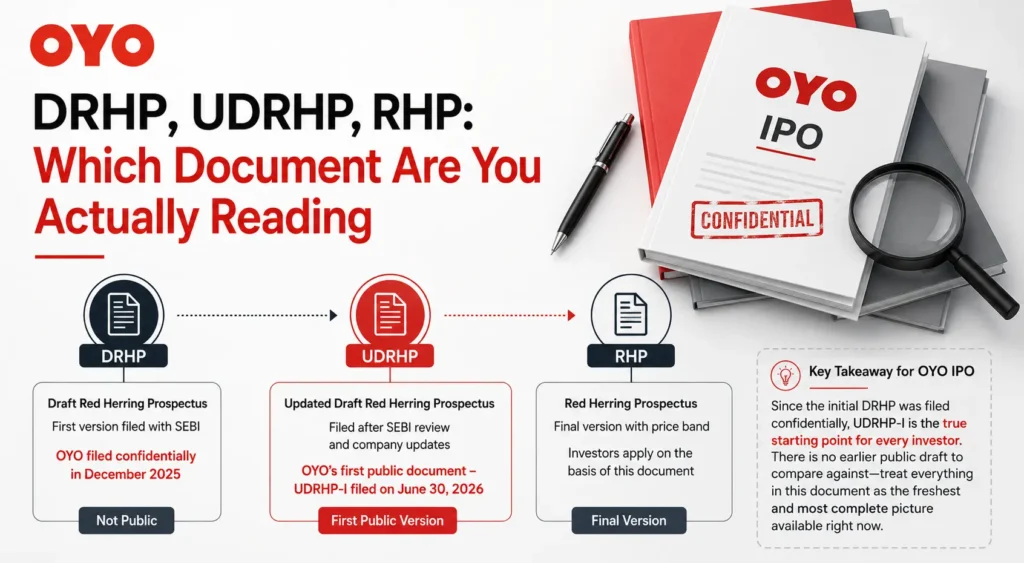
A Draft Red Herring Prospectus, or DRHP, is the first version of a company’s IPO document filed with SEBI. After SEBI reviews it and asks for changes, the company files an updated version called the UDRHP, or Updated Draft Red Herring Prospectus. Once everything is finalized, including the price band, the company files the Red Herring Prospectus, or RHP, which is the version investors ultimately apply against.
Here is something specific to OYO that most guides never mention. OYO’s parent company chose to file its first DRHP confidentially with SEBI in December 2025, which means the public never got to see that original draft at all. The first version any retail investor could actually read was the UDRHP-I, filed publicly on June 30, 2026. In practical terms, this means the UDRHP-I is your true starting point for this IPO. There is no earlier public draft to compare it against, so everything you read in that document should be treated as the freshest, most complete picture available right now.
Where to Actually Find OYO’s IPO Documents
This part is simpler than most people expect, and it is worth doing yourself rather than relying only on summaries.
OYO’s UDRHP is filed publicly with SEBI on its official filings page, which is the safest and most reliable place to read it directly. Once the company moves closer to launch, the same document, along with the final RHP, will also be available through the websites of the lead merchant bankers managing the issue, and later through the stock exchanges themselves.
One word of caution here. For an IPO as closely watched as OYO’s, you will come across screenshots, summaries, and secondhand claims about what the filing says, spread across social media and forums. Always go back to the SEBI filing or the exchange website for anything that really matters to your decision. Do not trust a screenshot that someone shared without any context.
Always check the SEBI filing or the exchange website for anything that really matters to your decision. Do not trust a screenshot that someone shared without any context. Always go back to the SEBI filing or the exchange website for anything that really matters to your decision. Do not trust a screenshot that someone shared without any context.
The Sections That Actually Matter, and the Order to Read Them In
A filing like this can run into hundreds of pages, and telling someone to simply read the whole thing is not realistic advice. Here is a more practical approach.
Start with the objects of the issue, since this tells you exactly what the company plans to do with your money. Move next to the risk factors, because this is where the company itself admits what could go wrong. After that, look at the financial statements to understand the actual numbers behind the story you have been reading in the news. Then review the business overview to understand how the company actually operates today, not just how it is marketed. Finally, check the promoter and litigation sections for anything that could affect long term stability.
This order works because the first two sections tell you the most important things fastest, where your money goes and what the company is worried about, before you get into the more descriptive, promotional parts of the document.
Objects of the Issue: What Is OYO Actually Doing With Your Money
This section answers a simple but crucial question. If you invest, what exactly happens to that money?
For OYO, the answer is clear and specific. Out of the ₹6,650 crore fresh issue, ₹4,987.5 crore is earmarked specifically to repay existing borrowings, with the remaining amount going toward general corporate purposes. If you want the full breakdown of what that debt is, where it came from, and why it matters so much, we covered it in detail in our article on OYO’s debt and IPO proceeds.
Here is the general lesson worth taking away, one that applies well beyond just this IPO. Whenever you see that a large share of an IPO’s proceeds is going toward repaying debt rather than funding new growth, pause and ask yourself what that tells you about the company’s current priorities. It does not automatically mean something is wrong, but it does mean you are buying into a balance sheet repair story as much as a growth story, and you should go in with that expectation clearly in mind.
Risk Factors: What OYO Itself Admits Could Go Wrong
This is genuinely one of the most valuable sections in any IPO filing, and also one of the most skipped.
The risk factors section is not a marketing document. It is the company’s own legally required admission of what could hurt its business, written by the company itself, reviewed by its lawyers and bankers, and filed with the regulator. Reading it gives you a far more honest picture than any news article or analyst opinion ever will.
For OYO specifically, two real examples stand out. One is an ongoing legal dispute with Zostel, where an unfavorable outcome could require OYO to give up a meaningful share of its equity or pay a significant cash settlement. The other is the debt servicing burden itself, since OYO has been paying substantial interest costs on its existing borrowings, something that directly eats into profitability until the IPO proceeds help bring that debt down.
Seeing real examples like this, rather than a vague description of what risk factors generally contain, is exactly what makes reading this section worthwhile. It moves you from abstract advice to actually understanding what could genuinely affect your investment.
Financial Statements: Reading Past the Headline Numbers
The financial statements section contains the company’s audited numbers, and this is where you check whether the growth story you have been reading about actually holds up.
Look at three things specifically. Is revenue growing consistently over the last few years, or is it lumpy and inconsistent. Is profit growing in a way that matches revenue growth, or is it jumping around due to one time items. And how much of any reported profit is coming from real operations versus accounting adjustments.
OYO’s own filing shows strong revenue growth and a sharp jump in reported profit for the first nine months of FY26. But headline numbers alone do not tell the full story. We went through OYO’s financials in much greater depth in our article on OYO’s PAT growth in 9MFY26, where we found that a meaningful portion of that reported profit came from one time items rather than pure operational improvement. This is exactly the kind of nuance that only shows up when you actually dig into the financial statements section yourself, instead of stopping at the headline profit figure.
Business Overview: The Shift Most Investors Miss
The business overview section is often treated as the least important part of a DRHP, mostly descriptive, mostly skimmed. That is a mistake, because sometimes the most important shifts in a company’s strategy are buried right here, in plain language, long before anyone in the news picks up on them.
OYO’s filing reveals exactly this kind of shift. Its company operated CheckIn premium hotels in India went from just 2.61 percent of the country’s gross booking value in FY24 to 49.29 percent by the first nine months of FY26. That is an enormous change in how OYO actually runs its India business, moving from a purely asset light listing platform toward something closer to a hands on hotel operator, and it is sitting quietly in the business overview section for anyone who takes the time to read it.
This is precisely why skimming past this section is a mistake. The headline growth and profit numbers tell you what happened. The business overview section often tells you why, and sometimes reveals changes that will matter far more over the next few years than this quarter’s profit figure.
Promoter and Shareholding Details: What No OFS Actually Signals
An Offer for Sale, usually shortened to OFS, is when existing shareholders sell some of their shares as part of the IPO, meaning that portion of the money goes to those shareholders rather than into the company.
OYO’s IPO has no OFS component at all. According to the filing, major shareholders including SoftBank, Ritesh Agarwal, Microsoft, Airbnb, Lightspeed, Peak XV Partners, Khazanah Nasional, and Greenoaks Capital are not selling a single share, and all of them will continue holding their stakes after listing.
It is tempting to read this as a strong, simple signal of confidence, and it certainly can be read that way. But a more balanced approach is to treat it as one data point among several, not a guarantee. Long term investors sometimes hold rather than sell for reasons that have little to do with future upside, including simply not wanting to lock in a disappointing return after years of holding through a much higher earlier valuation. Weigh this detail alongside everything else in the filing rather than letting it override your overall judgment on its own.
A Quick Correction: Don’t Waste Time on IPO Grading
Here is a small but genuinely useful correction. If you read other guides on how to evaluate a DRHP, several of them still tell you to check the IPO grading section. You will not find one in OYO’s filing, and that is not an error or an omission. SEBI discontinued mandatory IPO grading years ago, so this is simply not something companies are required to include anymore. If you see a guide still telling you to look for it, that is a sign the content has not been updated in a while.
A Simple Checklist Before You Apply
Here is a short, practical checklist to run through before you apply for any IPO, OYO included.
Confirm exactly what the company plans to do with the money it raises. Read the top few risk factors the company has disclosed about itself. Check whether revenue and profit have grown consistently over the last three years, and whether that profit is coming from real operations. Check whether existing promoters and major investors are selling shares or holding onto them. Look for any pending litigation or regulatory issues that could affect the company down the road.
Going through these five steps takes far less time than people expect, and it gives you a genuinely informed starting point before you ever look at grey market premium or subscription numbers.
Frequently Asked Questions
What should retail investors read before applying for the OYO IPO?
The UDRHP is the best place to understand OYO’s financials, risks, business model, and use of IPO proceeds. It is the company’s own detailed disclosure, reviewed by SEBI, and it contains far more useful information than headlines or social media chatter.
What is the difference between a DRHP and a UDRHP?
A DRHP is the first version of an IPO filing submitted to SEBI, while a UDRHP is the updated version filed after SEBI’s review and feedback. For OYO specifically, the UDRHP-I is the first version the public ever saw, since the company filed its original DRHP confidentially.
Where can I find OYO’s official IPO documents?
OYO’s UDRHP is available on SEBI’s official filings page, and it will later also be available through the lead merchant bankers’ websites and the stock exchanges once the final RHP is filed.
What are the most important sections of a DRHP to check?
The objects of the issue and risk factors sections are the most valuable starting points, followed by the financial statements, business overview, and promoter and litigation details.
Does OYO’s IPO have an Offer for Sale?
No. OYO’s IPO is a 100 percent fresh issue with no Offer for Sale, meaning existing shareholders including SoftBank, Ritesh Agarwal, Microsoft, and Airbnb are not selling any shares and will continue holding their stakes after listing.
Conclusion
Everything you read about OYO’s IPO online, every analysis, every headline, every opinion, ultimately traces back to one document, the company’s own UDRHP. The UDRHP is the best place to understand OYO’s financials, risks, business model, and use of IPO proceeds, and now you know exactly which sections matter, where to find them, and what OYO’s own filing already reveals once you actually look.
If you want to learn more, about a part of this report we have written about OYOs debt and the money it got from its initial public offering, OYOs profit growth and how good its profits are OYOs plan to grow and the companies it has bought and how much OYO is worth overall. We have articles that go into detail about these things and they are all based on the same report that this guide is talking about OYOs report.
This guide will be updated once OYO’s final RHP and price band are announced. For more coverage like this as OYO’s IPO moves forward, keep following Listing Updates.
This article is meant for informational and educational purposes only and does not constitute investment advice. Please read the official filing yourself and consult a financial advisor before making any investment decisions.