
Table of Contents
Summary
2026’s IPO pipeline includes over a dozen major names, from mega-caps like Reliance Jio and Flipkart to fast-growing startups like Zepto and PhonePe. But size and hype don’t tell the full story. This comparison lays out every major 2026 IPO side by side on the metrics that actually matter: profitability, revenue growth, and business durability. Most of the biggest, loudest names on the list are either not yet profitable or haven’t disclosed their numbers publicly. OYO stands apart, combining real scale with a 172 percent jump in net profit to Rs 623 crore in FY25 and 10 straight quarters of positive EBITDA, a combination almost no other company in this pipeline can currently match.
Key takeaways
OYO is the only large-scale IPO in the 2026 pipeline combining strong revenue, fast profit growth, and a sustained EBITDA streak.
Several high-profile names, including Zepto and Flipkart, are not yet profitable or haven’t disclosed profitability ahead of their IPOs.
Smaller profitable companies like Amagi and Garuda Aerospace are turning a profit, but at a much smaller scale than OYO.
Investors comparing 2026 IPOs should weigh fundamentals over hype, since the biggest names aren’t always the strongest businesses.
A former chairman of India’s own market regulator just joined the board of OYO’s parent company, weeks before that same regulator cleared the company’s IPO. That single detail tells you more about what has genuinely changed since 2021 than almost any growth number in this whole story.
This is OYO’s third attempt at going public. The first two failed, and most coverage explains why using the same tired reasons, weak markets, heavy losses, bad timing. Those things are true. They do not show us everything. The big difference this time is, in the way the company is run the way it is organized and even in the people who decided to slow the company down before it was ready. This article looks all three attempts together and it tells us exactly what was different each time what changed in the governance of the company what changed in the structure of the company and what changed in the people who made decisions for the company.
Three Tries, One Company
OYO first tried to go public in September 2021. It tried again through a smaller, quieter attempt in 2023. And its current, third attempt was cleared by SEBI on June 5, 2026, under the company’s newer global parent name, PRISM.
Each attempt tells its own story, and understanding all three side by side is the only way to really answer the question everyone keeps asking. What’s actually different this time?
Attempt One, 2021: What Actually Went Wrong
OYO filed its first DRHP in September 2021, seeking to raise ₹8,430 crore at a targeted valuation of $11 to 12 billion. The issue was structured as a ₹7,000 crore fresh issue combined with a ₹1,430 crore offer for sale, meaning early investors including SoftBank, Grab Holdings, Huazhu Hotels, and the family office of Hero Group’s Sunil Munjal were all lined up to sell part of their stakes alongside the company’s own capital raise.
The regulator was not convinced. SEBI returned the company’s draft papers with queries, raising concerns tied to OYO’s key performance indicators, outstanding litigation, and valuation. Behind those concerns sat a simple, hard number. OYO had reported a loss of ₹1,744.7 crore for FY21 alone, and the company was asking the public to buy into a story that had not yet proven it could turn a profit.
Attempt Two, 2023: The Quiet, Smaller Retry
OYO tried again in 2023, this time taking a different, more cautious approach. The company refiled under the confidential pre-filing route, cutting the issue size dramatically to somewhere between 400 and 600 million dollars, roughly ₹2,500 crore, entirely through primary issuance aimed at repaying debt rather than growth.
This attempt also did not reach the finish line. In May 2024, OYO withdrew its draft papers, citing plans to refinance around $1.2 billion in existing term loans through a $450 million dollar bond issuance, a move that would materially change its financial statements and require a fresh filing anyway. We covered how this refinancing effort connects to OYO’s current balance sheet in our article on OYO’s debt and IPO proceeds.
Attempt Three, 2026: What’s Genuinely Different
This is where the real story lives, and it goes well beyond just better numbers.
The governance signal nobody’s talking about enough. In May 2026, former SEBI Chairman Ajay Tyagi joined PRISM’s board as an independent director, just before SEBI’s clearance came through. That timing is not a coincidence. A former head of the very regulator that twice raised governance concerns about this company is now sitting on its board. This is exactly the kind of credibility signal institutional investors, who have been skeptical of OYO’s governance history, actually pay attention to.
The moment OYO’s own biggest backer hit the brakes. In an even more telling detail, OYO founder Ritesh Agarwal had actually pushed for a quicker listing in late 2025, but SoftBank, the company’s largest shareholder, opposed the timing and pressed the company to wait until its earnings were genuinely stronger. Think about how different that is compared to 2021, when the company moved forward with an IPO even though SEBI had their worries. This time the main shareholder decided to be careful of rushing.
A fundamentally more diversified business. The company is filing this time as PRISM, its global parent entity, not narrowly as OYO. PRISM now also owns Motel 6 and Studio 6 through the G6 Hospitality acquisition, along with Belvilla, DanCenter, Innov8 coworking spaces, and Weddingz.in, meaning India now makes up only about 30 percent of PRISM’s total revenue. That is a fundamentally different pitch than the narrow, India-heavy budget hotel story that tried to list in 2021. If you want the full picture of how this diversification actually works, we broke it down in our piece on how OYO makes money through its growth strategy and acquisitions.
A cleaner deal structure. This attempt is a 100 percent fresh issue with no offer for sale at all. Compare that to 2021, where early investors were cashing out alongside the company. This time, every rupee raised goes directly into the business, mostly toward paying down debt, something we cover in detail separately.
An actual profit track record. OYO now carries 12 consecutive quarters of EBITDA profitability heading into this filing, something it simply did not have during either of its earlier attempts. Neither 2021 nor 2023 could point to a genuine, sustained run of positive operating performance the way this attempt can.
Side by Side: All Three Attempts Compared
Looking at all three attempts together makes the shift obvious.
In 2021, OYO targeted an $11 to 12 billion valuation, with a mixed structure of fresh issue and offer for sale, no meaningful profitability track record, and no notable governance additions. The result was SEBI returning the papers with concerns.
In 2023, OYO targeted a much smaller figure, reportedly as low as $1.5 billion, through a confidential filing with a pure fresh issue aimed at debt repayment, still without a real profitability streak behind it. The result was a voluntary withdrawal tied to a planned refinancing.
In 2026, OYO is targeting $7 to 8 billion, entirely fresh issue with no OFS, backed by 12 straight quarters of EBITDA profitability and a former SEBI chairman now sitting on the board. The result, so far, is SEBI clearance and an active path toward listing.
The Valuation Rollercoaster Behind All Three Attempts
It helps to see just how much OYO’s valuation has actually moved over the years. The company peaked near a 10 billion dollar valuation back in 2019. Then came the pandemic, and SoftBank itself marked the company’s valuation down by roughly 70 percent to around 2.7 billion dollars during the depths of the downturn. By 2022, the company’s updated filing was still targeting closer to 9 billion dollars. By 2025, banker discussions had settled into a more modest 6 to 7 billion dollar range. Today, the company is targeting 7 to 8 billion dollars for this listing.
If you want to understand whether that current target actually makes sense given everything else going on, we went deep into that question in our article on OYO’s IPO valuation.
Clearing Up the Confusion Around This IPO
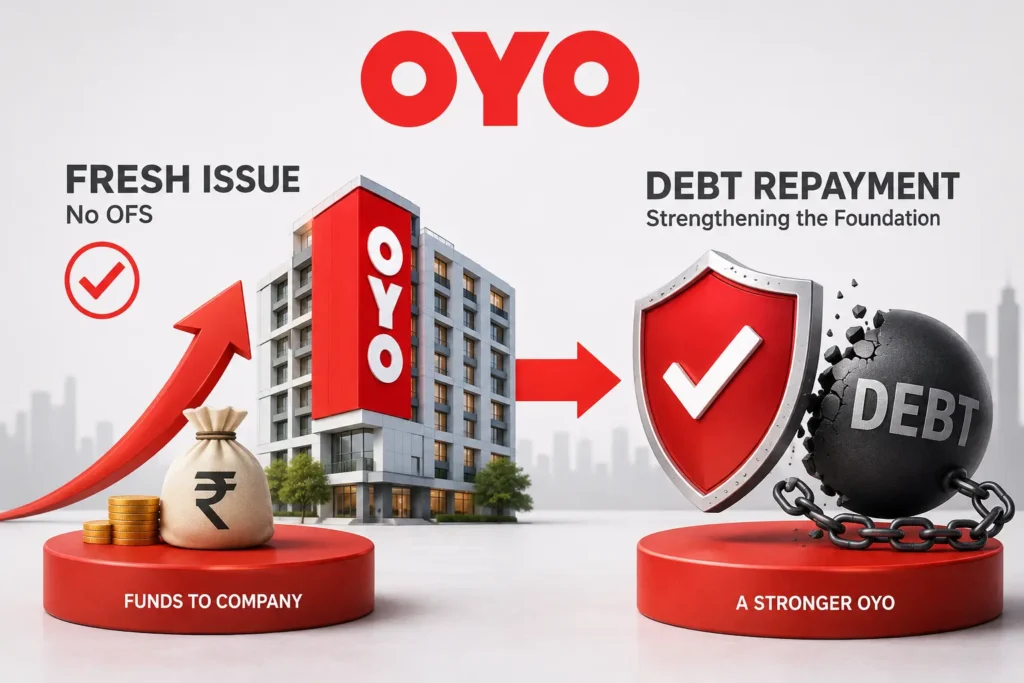
One more thing worth addressing directly. Reporting on this IPO has genuinely been inconsistent. Some sources have described a mixed structure with early investors selling shares alongside the company. Others correctly state the offering is entirely a fresh issue with no offer for sale component at all. Based on OYO’s own UDRHP, the second version is accurate. There is no OFS in None of this guarantees the listing will go smoothly, or that the stock will perform well once it lists.
The market can still be really unstable. That is what stopped the other two attempts.. The company that is trying to do this initial public offering now is really different from the one that tried before. It is different in the numbers. Also in how it shows itself to people who invest and to the regulators. This time every single rupee that the company gets from the public offering will go into the company. The main reason for this is to pay back the debt that the company already has. The company is using this public offering to repay its existing debt, which is a good thing, for the company.
What This Means Heading Into the Listing
Put all of this together and a clear picture emerges. Better governance optics through the Tyagi appointment. A more disciplined shareholder base that was willing to delay rather than rush. A more diversified, globally spread business. A cleaner, fully fresh issue structure. And a real, sustained profitability track record that simply did not exist during the previous two attempts.
Frequently Asked Questions
Why is OYO’s third IPO attempt different from 2021?
This attempt features a former SEBI chairman on the board, a fully fresh issue structure with no offer for sale, 12 consecutive quarters of EBITDA profitability, and a far more diversified global business, none of which existed during the 2021 attempt.
Why did OYO withdraw its IPO in 2021?
OYO’s first attempt was returned by SEBI over concerns about its key performance indicators, outstanding litigation, and valuation, at a time when the company was still reporting significant annual losses.
Why did OYO withdraw its second IPO attempt in 2024?
OYO withdrew its 2023 attempt in May 2024 to pursue a debt refinancing through a $450 million dollar bond issuance, which would materially change its financial statements and require the company to refile its documents anyway.
Does OYO’s 2026 IPO have an offer for sale?
No. OYO’s current IPO is structured entirely as a fresh issue with no offer for sale, meaning all the money raised goes directly to the company, unlike its 2021 attempt which included existing investors selling shares.
Who is Ajay Tyagi and why does his board appointment matter for OYO’s IPO?
Ajay Tyagi is a former Chairman of SEBI who joined PRISM’s board as an independent director in May 2026, just before SEBI cleared OYO’s current IPO. His appointment is widely seen as a governance credibility signal, directly addressing the kind of concerns that derailed OYO’s earlier attempts.
Conclusion
OYO isn’t just trying the same pitch a third time and hoping for better luck. The company walking into this listing has a former securities regulator on its board, a shareholder base that chose patience over speed, a genuinely global and diversified business, a cleaner deal structure, and an actual profit track record to point to. Whether that’s enough to finally get this company across the finish line will depend on execution and market conditions in the weeks ahead, but the underlying story is meaningfully different from the one that failed twice before.
For the fuller picture on OYO’s financials, growth strategy, and IPO valuation, explore our complete coverage, including OYO’s PAT growth and profitability, and track the latest on its listing timeline through our OYO IPO tracker.
For more coverage like this as OYO’s IPO moves forward, keep following Listing Updates.